Guides
What is a white-label reseller platform?
A white-label reseller platform lets you buy domains, mailbox licences or phone numbers at wholesale and sell them under your own brand and price.
The short answer
A white-label reseller platform is a wholesale supplier with an account, a control panel and usually an API, through which you buy services such as domains, mailbox licences or phone numbers and sell them to your own customers under your own brand. You pay the wholesale price, set the retail price yourself and keep the difference, and in return you own billing, first-line support and the risk of a customer not paying. That is what separates it from an affiliate programme, which pays a commission on someone else's sale, and from a marketplace, where the vendor's brand and price stay in front of the buyer.
A white-label reseller platform is a wholesale supplier that lets you buy a service, such as a domain, a mailbox licence or a phone number, and sell it to your own customers under your own brand. You pay a wholesale price, choose the retail price, and keep the difference; the platform stays out of sight.
The rest of this guide covers who uses these platforms, what is sold through them, how the money moves, and how the model differs from affiliate programmes and marketplaces. Prices and programme rules are quoted from the vendors' own pages as they stood in October 2026.
What a white-label reseller platform actually is
A white-label reseller platform is three things in one account: a supply of products at wholesale, a way to order them (a control panel, an API, or both), and a balance or credit line that pays for them. "White-label" means the end customer deals with your brand, your prices and your invoices, not the supplier's.
Three parties are involved:
- The upstream supplier makes or controls the product: a domain registry, Google or Microsoft, a telephone carrier.
- The platform holds the accreditation or contract with that supplier, aggregates supply and exposes it to resellers.
- The reseller owns the customer relationship: the price, the invoice, first-line support and the decision about who to sell to.
The platform's value is the layer in the middle. Becoming an ICANN-accredited registrar carries an accreditation fee of $4,000 per year under ICANN's fiscal year 2026 fee schedule (announced 21 July 2025), before any registry deposits or engineering. Buying Microsoft 365 directly from Microsoft as a "direct bill" partner requires, among other conditions, at least USD one million in trailing twelve-month CSP revenue (page dated 15 May 2026). A reseller platform lets a small business sell the same products without meeting either bar.
Who uses one
White-label reseller platforms are used by businesses that already have customers and want to add infrastructure to what they sell. Three groups are the typical users:
- Agencies (web, marketing, outbound sales) that set up domains, mailboxes and numbers for clients anyway and would rather bill for them than send clients to a third party.
- Managed service providers that run a customer's IT and resell the software licences that go with it. Microsoft's indirect model is the route for smaller partners: an indirect reseller needs programme membership, signing authority and a partnership with an authorised distributor.
- SaaS products and hosting companies that embed the purchase in their own app. Name.com markets its domain API to exactly this group and names Vercel, Netlify, Replit and Railway among its users (as listed in October 2026).
Scale varies widely. OpenSRS, a Tucows business, says it serves 13,000+ resellers (October 2026); that figure is the vendor's own and is not independently audited.
What gets resold
The three products most often resold this way are domains, mailbox licences and phone numbers, and each has a different supply chain and a different commitment.
| Product | What the reseller buys | Who sits upstream | Typical commitment | Example published terms (October 2026) |
|---|---|---|---|---|
| Domains | A registration, per name per year | Registry, via an accredited registrar | One to ten years, paid up front | OpenSRS offers 730+ endings; ICANN charges registrars $0.20 per domain-year |
| Mailbox licences | A seat on a Google Workspace or Microsoft 365 plan, per user per month | Google or Microsoft, usually via a distributor | Monthly or annual term | For per-user licences Microsoft gives a prorated refund only within seven calendar days of purchase |
| Phone numbers | A number rental, per month, plus usage | Carriers, via a communications API | Monthly | A US local number lists at $1.15 per month at Twilio and from $1 per month at Telnyx |
Two details are easy to miss. First, a mailbox licence is not a mailbox: the reseller sells the right to use Google's or Microsoft's service, and the mail itself stays with that vendor. Second, phone numbers are rarely sold through a formal "reseller programme". Communications APIs support resale structurally instead. Twilio's subaccounts let you "segment each of your customers' use of Twilio", and it bills all subaccount usage to your main account, which leaves the retail price and the invoice to you.
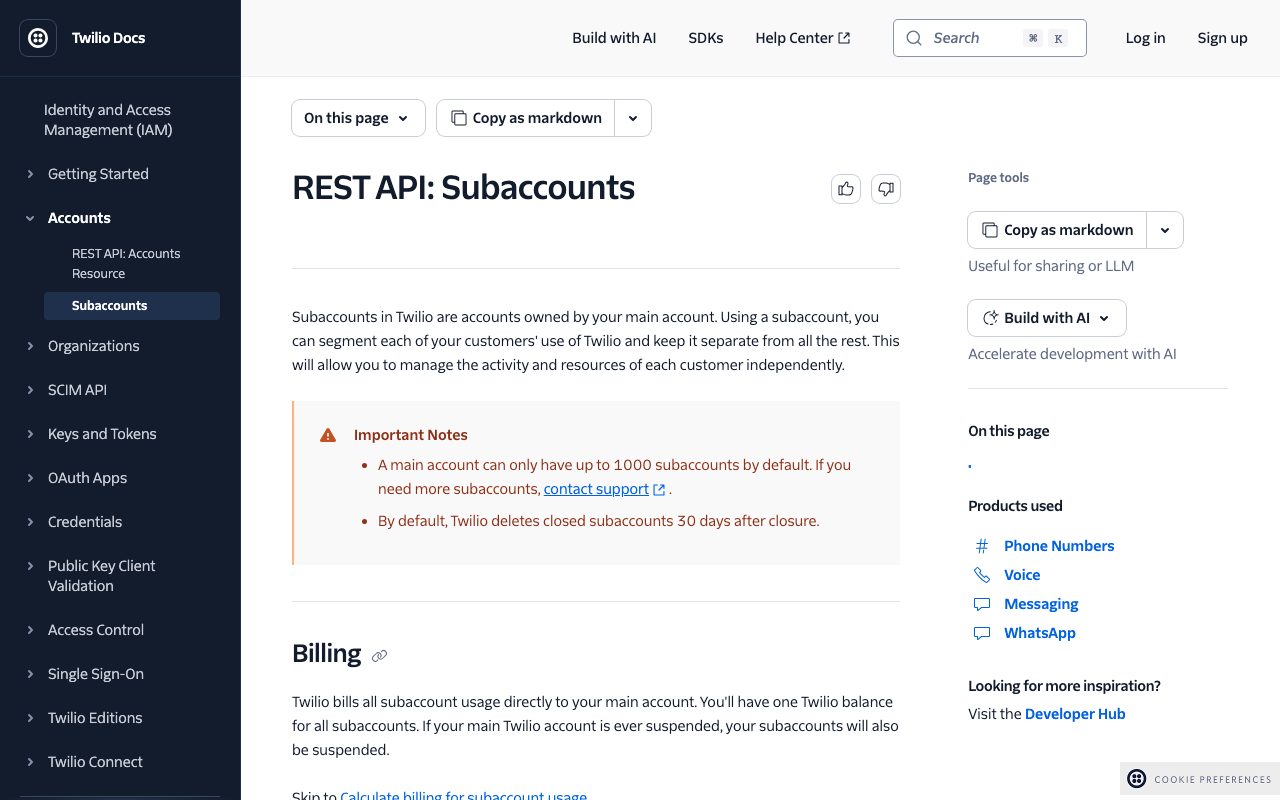
Twilio documents subaccounts as the way to keep each customer's usage separate. Screenshot of twilio.com, taken on 7 October 2026.
The three supply chains are separate. Registrar programmes sell domains (OpenSRS's payment terms also mention digital certificates and email boxes), cloud distributors sell licences, and communications APIs rent numbers. No count of platforms that combine all three was found, so a reseller who needs all three should expect to check several catalogues and may end up holding several accounts. Our guides to domain reseller APIs and becoming a Google Workspace reseller go deeper on two of those chains.
The three kinds of platform
White-label reseller platforms fall into three groups, and they differ mainly in what they charge for access.
| Type | Examples | How you pay for access | What each is best at |
|---|---|---|---|
| Registrar reseller programme | OpenSRS, Openprovider, Name.com | OpenSRS: one-time $95 activation fee and tiered pricing by volume. Openprovider: membership from $4.16 per month, billed annually, for domains at cost price. Name.com: "No fees, no application, no sales call" | A large published catalogue: 730+ endings at OpenSRS and 1,200+ at Openprovider; a membership instead of a per-name markup (Openprovider); sign-up without an application (Name.com) |
| Cloud distributor or agency marketplace | Microsoft's authorised distributors, Vendasta, HighLevel | Vendasta: $0 subscription against a minimum spend of $99, $499 or $999 per month. HighLevel: $497 per month for the plan that adds reselling with markup | Access to Microsoft licences without the direct-bill bar (distributors); a catalogue of 250+ products (Vendasta); rebilling phone and email usage to client sub-accounts with a markup (HighLevel) |
| API-first infrastructure platform | Twilio, Telnyx | Pay as you go, per number and per message | Programmatic control and published per-unit prices; Telnyx's US local number price falls in volume tiers to $0.25 per month beyond 5,000 numbers |
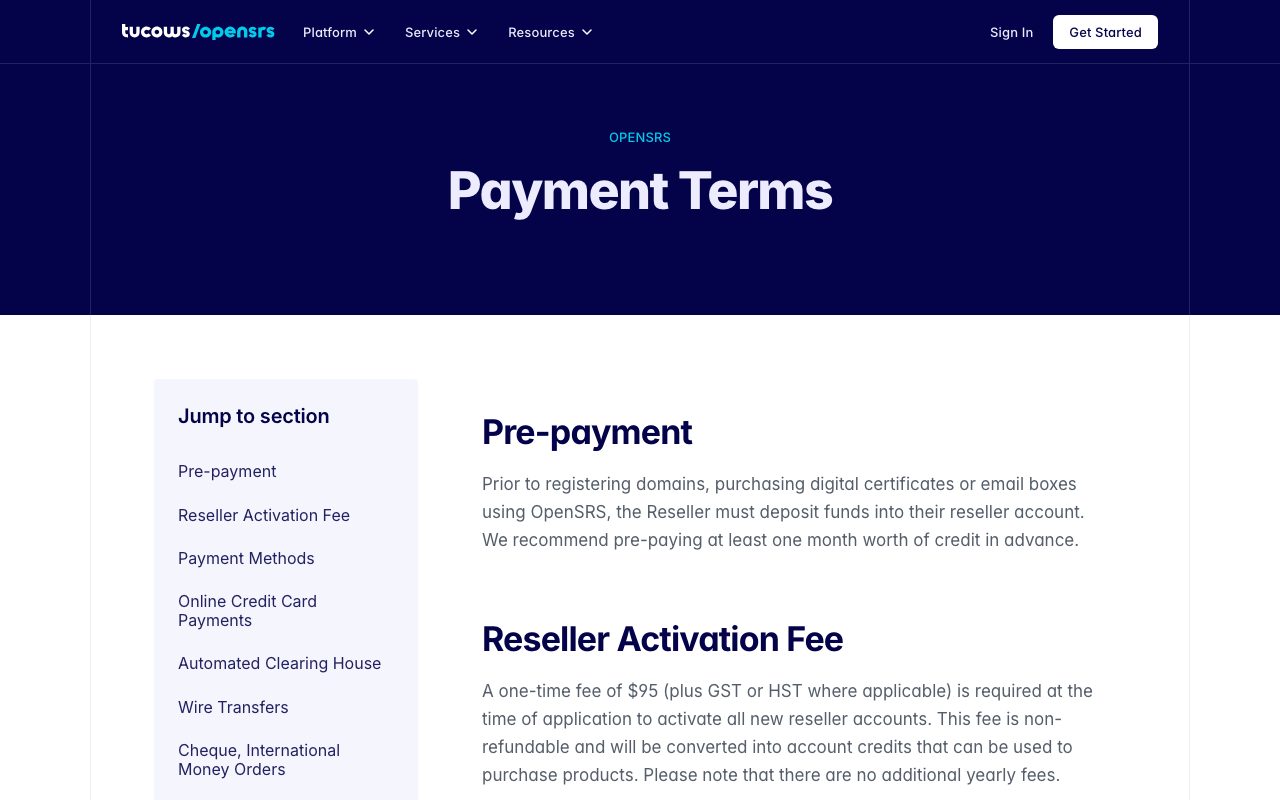
OpenSRS asks resellers to deposit funds before they register anything, and charges a one-time activation fee. Screenshot of opensrs.com, taken on 7 October 2026.
All prices are list prices on the vendors' pages in October 2026.
The white-label surface differs too. Some platforms hand you a ready-made shop: OpenSRS's Storefront is free with an account and takes $0.75 per order. Others give you only an API and expect you to build the customer-facing part.
How the money flows
Money in a white-label model moves in the opposite direction to the product: the customer pays you at your retail price, and you pay the platform at wholesale, usually before the product is delivered.
- You fund an account. Prepaid balances are common among registrar platforms. OpenSRS states that "the Reseller must deposit funds into their reseller account" before registering anything, and adds a 3% processing fee on deposits made by card or PayPal.
- An order draws down the balance at the wholesale price.
- You invoice your customer at whatever price you choose, on whatever schedule you choose.
- The difference is your gross margin, out of which you pay for support, payment processing and any platform fee.
As a worked example from published prices only: OpenSRS's default Essential tier lists a .com registration at $14.50 per year on its pricing page, read on 11 October 2026, with $15.25 scheduled to take effect on 1 November 2026. A reseller charging $20 would gross $5.50 on that name per year at the current price, before the 3% card fee on the deposit. That is arithmetic, not a benchmark. No independent survey of reseller margins was found, and CentralNic Reseller, itself a wholesale domain supplier, wrote in September 2026: "There's no universal margin number, and anyone offering one is selling something."
Prepaid is not the only arrangement. Google's public reseller agreement invoices partners at the price list less the applicable discount, due net 30 days, with interest of 1.5% per month on overdue amounts. Microsoft's cancellation policy (page dated April 2025) puts the customer's credit risk on the partner: "the partner is responsible for payment of any outstanding amounts regardless of whether the customer can't pay or refuses to pay".
So a reseller carries one of two burdens: cash tied up in a prepaid balance, or liability for a term the customer may walk away from. Our article on prepaid wallet billing for resellers covers holds, refunds and what happens when a renewal meets an empty balance.
How it differs from affiliate and marketplace models
White-label reselling, affiliate programmes and marketplaces differ in who owns the customer, who sets the price and who carries the risk.
| White-label reseller | Affiliate | Marketplace | |
|---|---|---|---|
| Whose brand the buyer sees | Yours | The vendor's | The vendor's, inside the marketplace |
| Who sets the price | You | The vendor | The vendor |
| How you earn | Markup over wholesale | A commission on the vendor's price | Not applicable: the vendor pays the marketplace a fee |
| Who bills and supports the customer | You | The vendor | The vendor, with the marketplace collecting payment |
| Who carries bad debt | You | The vendor | The vendor |
| Published example (October 2026) | Vendasta's $99 per month minimum spend; OpenSRS's prepaid deposit | Instantly pays 20%, 30% or 40% recurring commission by referral tier | AWS Marketplace takes 3% on public SaaS subscriptions (since January 2024); Microsoft takes a 3% agency fee |
The percentages in that table are not comparable with each other. An affiliate commission is a share of a price someone else set, earned with no operational work. A reseller's markup is a number you choose, but it has to pay for the invoicing, support and credit risk that the affiliate never touches.
A simple way to choose: if you only want to recommend a product, be an affiliate. If you built the product and want distribution, list it on a marketplace. If you want the product to be part of your own offer, with your name on the invoice, you want a white-label platform.
What to check before you pick one
The questions that separate reseller platforms are practical ones, and most can be answered from a vendor's pricing page and documentation before you sign up.
- Is the wholesale price published? Some vendors show a price list; others show it only after login or a sales call.
- What does access cost? Compare activation fees, memberships, minimum spend and per-order fees, not just unit prices.
- Prepaid or postpaid? And if prepaid, is there a fee to top up, and what happens to a renewal when the balance is short?
- How long are you committed? A monthly number rental and an annual licence term are very different liabilities.
- Is there an API and a test environment? If you plan to automate ordering, check for a sandbox, retry safety and event notifications. See idempotency keys and webhooks for reseller APIs.
- Who answers the customer? Under Google's agreement the partner must try to resolve support issues "without escalation to Google". Ask any other supplier where its support boundary sits.
Where ResellerHQ fits
ResellerHQ is an API-first white-label reseller platform that puts phone numbers, domains and mailbox licences (Google Workspace and Microsoft 365 seats, not the mailboxes themselves) behind one prepaid wallet and one REST API. It is in early access, and its limits are worth stating plainly:
- Domains and mailbox licences can be ordered in the sandbox only. On the live side those routes answer
422 not_available. - Live phone numbers are available only on accounts with an upstream carrier enabled, and depend on that upstream provider.
- There is no public price list. Wholesale prices are shown in the dashboard and by the API before you order, and sandbox prices are test prices.
- Live wallets are funded by invoice; card payments are not connected yet.
If you need to register real domains or provision real licences today, ResellerHQ cannot do that yet; a registrar programme or distributor such as those in the tables above can. The docs describe what works now, and an account with a sandbox can be created without a card.
Questions
- It is a wholesale service that lets a business buy products such as domains, mailbox licences or phone numbers and sell them under its own brand at its own price. The platform handles supply and provisioning; the reseller handles the customer, the invoice and first-line support.
- They keep the markup, which is the gap between the wholesale price they pay the platform and the retail price they charge. No neutral benchmark for a typical markup was found, so treat any quoted margin as a vendor claim and work it out from published wholesale prices.
- An affiliate refers a buyer to the vendor and earns a published commission, with no control over price and no billing or support duty. A white-label reseller buys the product, sets the price, invoices the customer under its own brand and carries the support and credit risk.
- Not to resell domains: a reseller account sits under an accredited registrar. Reselling Microsoft 365 as an indirect reseller needs membership of Microsoft's partner programme and a partnership with an authorised distributor, and reselling Google Workspace as a Google partner means accepting its reseller agreement.
- A prepaid balance means the platform is paid before it buys from its own supplier, so it carries no credit risk on the reseller. OpenSRS, for example, requires resellers to deposit funds before registering a domain. Not every programme is prepaid: Google invoices its Workspace resellers net 30 days.
- The three products come from separate supply chains: registrar reseller programmes sell domains, cloud distributors sell software licences and communications APIs rent numbers. No count of platforms that combine all three was found, so check each vendor's catalogue; a reseller who needs all three may hold several supplier accounts.
Sources
- OpenSRS: Payment terms opensrs.com
- OpenSRS: Domain pricing opensrs.com
- OpenSRS: Storefront overview opensrs.com
- Openprovider: Membership plans openprovider.com
- Name.com: Domain reseller API name.com
- ICANN: Registrar-level fees for fiscal year 2026 icann.org
- Microsoft Learn: Cloud Solution Provider program overview learn.microsoft.com
- Microsoft Learn: New commerce experience cancellation policy learn.microsoft.com
- Google Workspace: Reseller agreement, North America workspace.google.com
- Twilio: Subaccounts documentation twilio.com
- Twilio: SMS pricing in the United States twilio.com
- Telnyx: Numbers pricing telnyx.com
- Vendasta: Pricing vendasta.com
- HighLevel: Pricing gohighlevel.com
- Instantly: Affiliate programme instantly.ai
- AWS: Marketplace listing fees, January 2024 aws.amazon.com
- Microsoft: Marketplace for software companies microsoft.com
- CentralNic Reseller: Pricing strategies every domain reseller should know centralnicreseller.com