Guides
How to become a Google Workspace reseller in 2026
To resell Google Workspace you need a signed Google reseller contract, or a distributor or wholesale platform that holds one. Steps, prices and terms.
The short answer
You become a Google Workspace reseller by joining Google's partner programme, signing its reseller agreement with the Workspace product schedule, and being accepted into a resale engagement model; only then do you get the Partner Sales Console and the Reseller API. If you cannot or do not want to meet that bar, the alternatives are to buy through a distributor or a wholesale platform that holds the contract for you. Google does not publish the partner discount, so any margin figure you read is second-hand.
To resell Google Workspace under your own contract you must join Google's partner programme, sign its reseller agreement with the Workspace product schedule, and be accepted by Google into a resale engagement model. If that bar is too high, you buy the same licences through a distributor or a wholesale platform that already holds the contract, and give up some margin and control in exchange.
This guide separates what Google states in public from what sits behind the partner login. Where a number is not public, it says so instead of guessing.
The short version: three routes
There are three ways to sell Google Workspace licences, and they differ mainly in who signs with Google and who carries the invoice.
| Direct with Google | Through a distributor | Through a wholesale platform | |
|---|---|---|---|
| Who holds the Google contract | You | The distributor | The platform or its upstream |
| Entry bar | Signed agreement, acceptance into an engagement model, Program Guide requirements (Google) | Set by the distributor; not published on the pages we opened | Usually an account and a balance or card |
| How you pay | Invoiced, net 30 days, non-refundable (Google) | Distributor terms | Often prepaid or per mailbox per month |
| Your price | Price list less a Program Guide discount, not public (Google) | Not published | Sometimes published per mailbox |
| Provisioning | Partner Sales Console and Reseller API | Distributor marketplace | Platform dashboard or API |
| Best for | Established resellers with volume and a support desk | MSPs who already buy Microsoft 365 the same way | Small or new sellers, and software that needs licences by API |
What Google requires to resell directly
Google's public agreement makes the right to resell conditional on three things. The North America version says the right applies only when the partner and Google "have executed the applicable Product Schedule(s)", the partner "has been accepted by Google in writing (including via email) into a particular Engagement Model", and the partner "has satisfied the requirements in the Program Guide" (Google reseller agreement, fetched 7 October 2026).
The Program Guide is where the practical requirements live, and it is not public. Google can also change it with at least 30 days' written notice of any material change (same agreement).
The programme around the contract changed in 2026. Google announced the Google Cloud Partner Network on 17 December 2025, with rollout in Q1 2026, a six-month transition window, and three tiers: Select, Premier and a new Diamond tier. Tiers are "determined based on exceptional customer outcomes across Google Cloud and Google Workspace" (Google Cloud Blog, December 2025).
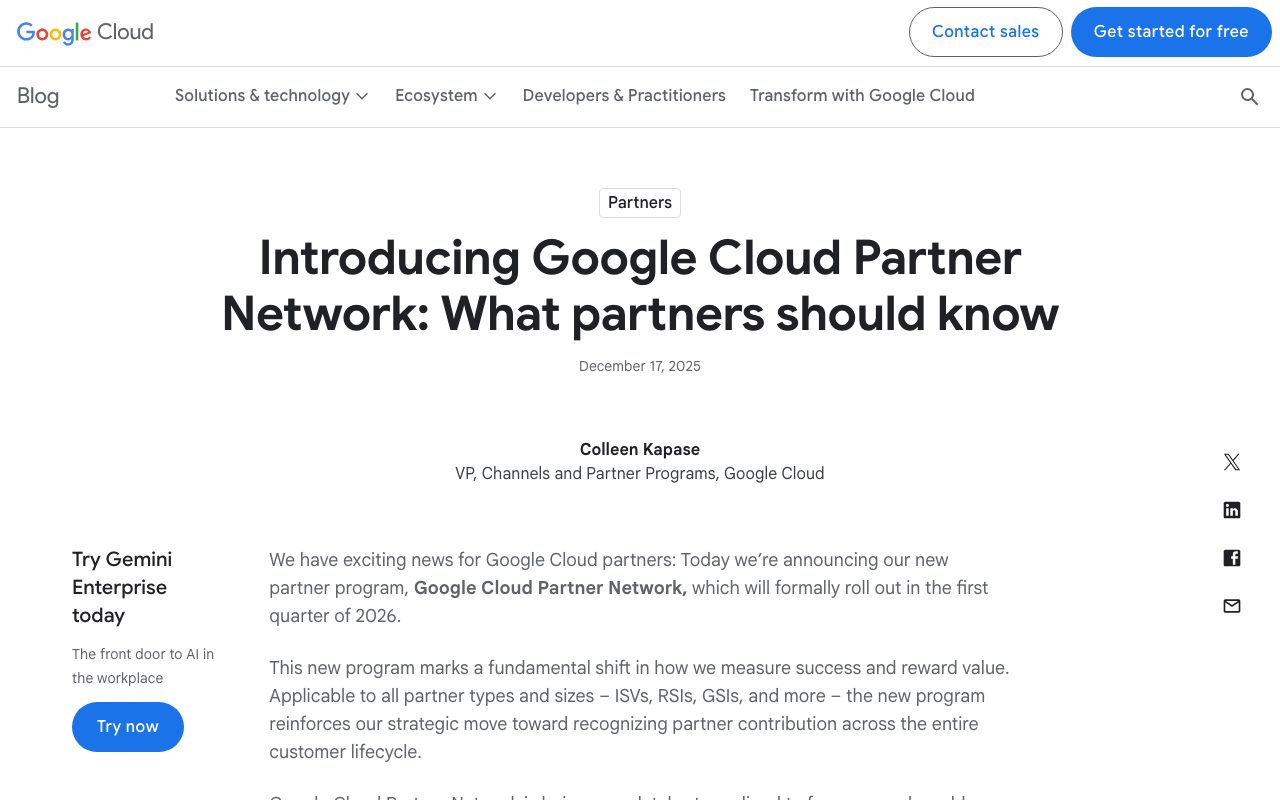
Google announced a new partner programme, Google Cloud Partner Network, in December 2025. Screenshot of cloud.google.com, taken on 7 October 2026.
Google's post gives no thresholds. CRN Australia reported them as $250,000 of partner co-sell annual contract value for Select, $2 million for Premier and $20 million for Diamond, with Diamond also needing 20 partner-implemented workloads, 30 co-sell influenced opportunities and 200 professional certifications (CRN Australia, 2026). The article does not say whether those are US or Australian dollars, and Google has not published the figures itself. Those are tier thresholds for the whole Google Cloud programme. Neither source says which tier, if any, is needed before you may resell Workspace, so ask Google that question directly.
Two claims you will see repeated are worth treating with care:
- "You need 100 seats first." A Vendasta article from November 2022 says Google mandates "a minimum of 100 provisioned seats" and a credit check (Vendasta). It links no Google source and dates from 2022. We found no Google page that confirms it.
- "You need certified staff." Sherweb says going through it avoids requirements "like having a specified number of specializations or certified staff" (Sherweb, article dated 10 April 2023). Sherweb is a distributor describing its own alternative and links no Google source. The 2026 tier criteria above do count certifications, but no public page gives a number required for Workspace resale.
What the contract commits you to
A direct reseller carries the credit risk, the first line of support and the customer paperwork. The public agreement is specific on each (Google reseller agreement):
- Payment. Fees are "due net 30 days from the invoice date" and are non-refundable. Overdue amounts can attract interest of 1.5% per month, or the legal maximum if lower.
- Price changes. A change to the price list takes effect 30 days after Google's notice unless Google gives longer.
- Customer terms. You must make sure each customer "is notified of and accepts the Google TOS, with no alteration or amendment" before first login.
- Support. You must use "commercially reasonable efforts to resolve, without escalation to Google" customer support issues.
- Exit. Either side can terminate for convenience on 90 days' written notice.
- Sub-resale. You may sell to other authorised resellers for onward resale, provided they are listed in Google's partner directory.
In plain terms: Google invoices you whether or not your customer has paid you. If you plan to bill customers monthly in arrears, you need working capital to cover the gap. Our article on prepaid wallet billing for resellers covers the opposite model.
Direct or through a distributor
Go direct if you have the volume to meet the programme and the staff to run billing and support; go through a distributor if you want Workspace on the same invoice as the rest of your catalogue. A distributor signs with Google, takes the invoice, and resells to you under the sub-resale clause.
What we could verify about named distributors is limited:
- Sherweb offers Google Workspace to resellers and positions itself as a way round Google's direct requirements (Sherweb, April 2023). The page gives no margins or minimums.
- Vendasta sells Workspace through its marketplace and says it lets partners "skip all of the hassles" of qualifying (Vendasta, November 2022). No reseller margin is stated.
- Pax8, best known for Microsoft CSP distribution, began offering Google products in Australia and New Zealand in 2026. The launch covered Chrome OS, Chrome Enterprise Premium and Gemini Enterprise; Google Workspace was due "in a few weeks", with Asia and other regions to follow at dates the article does not give (CRN Australia, 2026). Check availability in your country before planning around it.
Distributor buy prices, minimum commitments and margin splits: not found on any page we could open. Ask each distributor for its price file, its payment terms, and whether you may hold the customer relationship and move it later.
If you also sell Microsoft 365, the distributor route will feel familiar, because Microsoft requires at least 12 months as an indirect reseller buying through a distributor before a partner can apply for direct-bill status (Microsoft, page dated 15 May 2026). See the Microsoft 365 CSP reseller guide and the side-by-side in Google Workspace vs Microsoft 365 for resellers.
What the Reseller API does
The Reseller API lets a contracted reseller create customers and manage their subscriptions from code instead of the Partner Sales Console. Google's prerequisites page is blunt: "You must have a fully executed and signed reseller contract to use the Partner Sales Console and the Reseller API" (Google, page updated 3 September 2026).
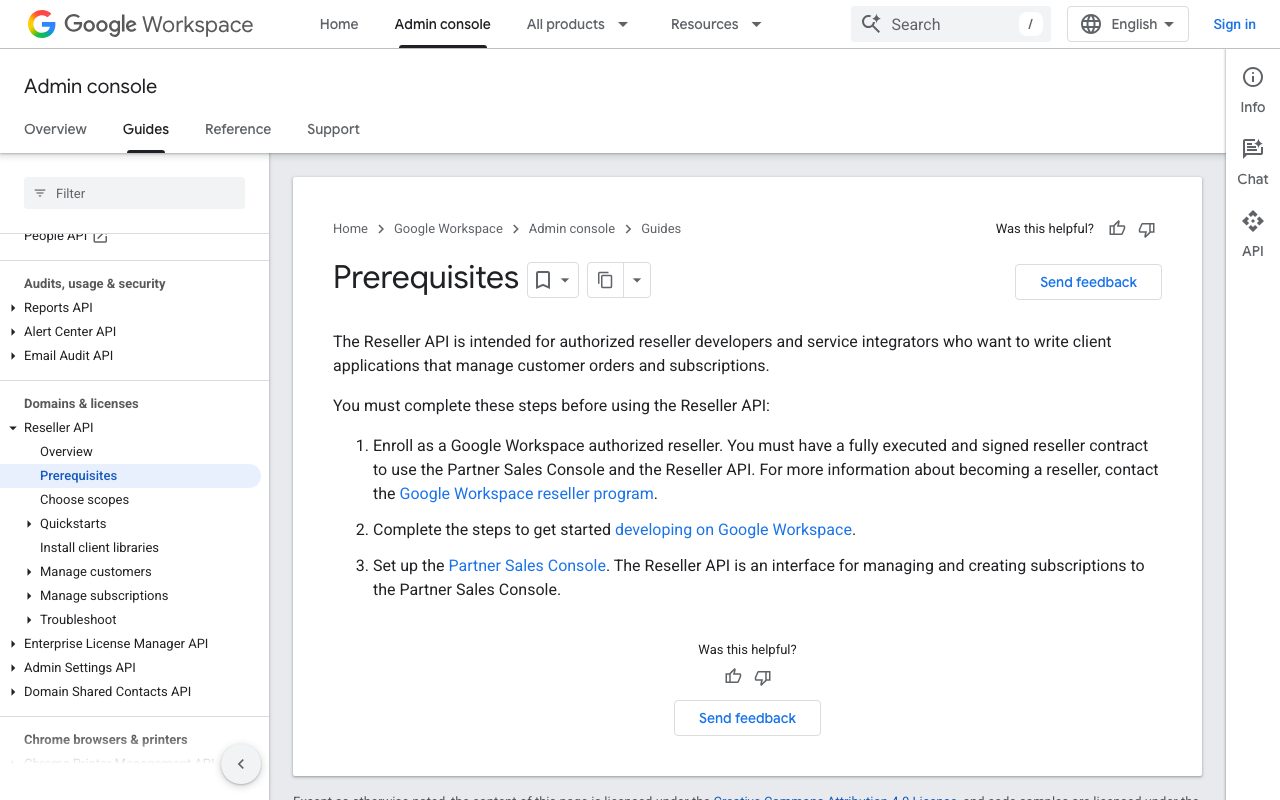
Google requires a signed reseller contract before the Reseller API can be used. Screenshot of developers.google.com, taken on 7 October 2026.
What it covers, per Google's documentation as of September 2026:
- Customers. You create a customer with a primary domain name, an alternate email and a physical address, then add a subscription for each product SKU (concepts).
- Subscriptions. A subscription ties together the payment plan, the SKU, the user licences, trial status and renewal options. Its
subscriptionIdchanges when the subscription changes, so do not use it as a permanent key in your database (concepts). - Renewal settings. Options include auto-renew with yearly or monthly pay, renew for current users only, switch to pay-as-you-go, and cancel, which suspends the subscription at the end of the term (manage subscriptions).
- Transfers in. A customer who already pays Google or another reseller generates a transfer token specific to your reseller ID. It is valid for 30 days (manage subscriptions).
Plans and commitment terms
Google sells Workspace to resellers on annual commitment, flexible or trial plans, and the choice decides how much risk you carry.
| Plan | What you commit to | Seat changes | Source |
|---|---|---|---|
| Annual commitment, paid monthly or yearly | A fixed number of licences for one year | Seats can be added; the plan cannot be downgraded mid-term | |
| Flexible | Nothing; Google describes it as a non-commitment plan with monthly payments and charges you each time the customer creates a user | Users can be added up to the maximum number of seats set on the subscription | |
| Trial | Free for up to 30 days | Can be switched to flexible or annual during the trial |
Two details catch new resellers out. First, an annual plan is your liability for the full year even if the customer leaves in month three, because the fees are non-refundable. Second, trial accounts send at most 500 messages per user per day, against 2,000 on a paid account, and the higher limit arrives only after the domain "has cumulatively paid at least $100 USD", which can take up to 75 days (Google, Gmail sending limits). If your customers buy mailboxes for outreach, read cold email infrastructure: domains and mailboxes before promising day-one volume.
Current list prices
The last US list prices we could verify are from January 2025, when Google folded Gemini into the Business editions and raised prices for new customers from 16 January 2025 (9to5Google, 15 January 2025).
| Edition | Annual plan, per user per month | Flexible plan, per user per month |
|---|---|---|
| Business Starter | $7 (was $6) | $8.40 (was $7.20) |
| Business Standard | $14 (was $12) | $16.80 (was $14.40) |
| Business Plus | $22 (was $18) | $26.40 (was $21.60) |
Source for every cell: 9to5Google, 15 January 2025. In each row the flexible price is 20% above the annual price; that is our arithmetic from the figures above.
Check the live page before you quote a customer. When we opened Google's pricing page on 7 October 2026 it was served in Indian rupees and showed a different line-up. Regular prices per user per month were ₹99 for Base (at most 20 users), ₹270 for Starter and ₹1,080 for Standard (both up to 300 users), with introductory discounts on Base and Standard, and Enterprise by contacting sales. Current US dollar prices from Google's own page: not found. That page shows no Enterprise price.
Realistic margins
Google does not publish the reseller margin. The agreement defines only the formula: you pay "the price stated on the applicable Price List, less the applicable discount stated in the Program Guide" (Google reseller agreement). The discount is in the gated guide.
The one dated public data point points down, not up. Channelnomics reported on 2 April 2024 that Google was "slashing the renewal discounts on its popular Workspace productivity suite by 40%, effective April 1", and that the move came as Google "pivots more of its channel rewards and incentives to new customer acquisition" (Channelnomics). That is a 40% cut to the discount, not a 40-point fall in margin, and the before and after percentages are not in the part of the article that can be read without signing up.
So plan on these assumptions:
- The licence discount is thin and weaker on renewals than on new business.
- A distributor or platform in the middle takes part of it.
- Your profit comes from what you add: setup, migration, DNS, support, security configuration, and bundling the licence with domains or other services at a price you set.
Buying licences through a wholesale platform instead
A wholesale platform is the route with the lowest entry bar: you open an account, pay per mailbox or per seat, and never sign with Google yourself. It suits software products that need licences on demand and small sellers who cannot justify a partner programme.
Some of these platforms publish prices, which distributors rarely do. InboxKit lists Google Workspace and Microsoft 365 mailboxes at $2.50 per mailbox per month on annual billing and $3.00 on monthly billing (InboxKit pricing, opened October 2026). Premium Inboxes lists $3.50 per inbox per month for 1 to 249 inboxes, falling to $2.80 at 1,250 or more (Premium Inboxes pricing, opened October 2026). Both sell to outbound sales teams, and both prices are below the $7 Business Starter list price from January 2025. Neither pricing page says how the licences are sourced or which Google edition is supplied, so ask which edition you get, who is the reseller of record, who owns the admin account, and what happens to the mailboxes if you leave.
Where ResellerHQ fits
ResellerHQ, the publisher of this article, is a platform of this third kind, and it cannot take live Workspace orders yet. Its API models Google Workspace and Microsoft 365 licences as seats on a plan for one customer domain, from 1 to 300 seats per licence, paid from a prepaid wallet (ResellerHQ docs).
The limits matter more than the design today. Mailbox licences can be ordered in the sandbox only; on the live side the routes answer 422 not_available, and sandbox licences are not provisioned with Google. Monthly renewal is not automatic, and pro-rated billing and assigning seats to named users are not built. ResellerHQ publishes no price list. If you need to sell real Workspace seats this quarter, use Google directly or one of the distributors above. If you are building a product and want to wire up ordering, seat changes and wallet billing ahead of time, the docs and a sandbox account, which uses test funds and needs no card, are the place to test.
Questions
- No. Google's reseller agreement gives the right to resell only once the product schedule is signed, Google has accepted you in writing into an engagement model, and you meet the requirements of its Program Guide. Without that contract you can still sell Workspace by buying through a distributor or wholesale platform that has one.
- Google does not publish it. The public agreement says a partner pays the price list less a discount stated in the partner-only Program Guide, and trade press reported in April 2024 that Google cut renewal discounts by 40%. Treat any percentage quoted on a blog as unverified.
- No public Google page we could open states a seat minimum. A 2022 Vendasta article claims a 100 provisioned seat minimum plus a credit check, but it links no Google source, so confirm the current rule with Google or your distributor.
- No. The Partner Sales Console does the same work by hand, and the Reseller API is an interface to it. The API matters when you want to create customers, change seats and set renewals from your own billing system, and it requires a fully signed reseller contract.
- Yes. The customer generates a transfer token that is specific to your reseller ID, and you use it to transfer the subscription. Google's documentation says the token is valid for 30 days.
- Not during the term. Google's Reseller API documentation says "You can't downgrade annual plans in the middle of their term", so reductions only take effect at renewal. Google describes the flexible plan as a non-commitment plan with monthly payments.
Sources
- Google Workspace: Google Cloud Partner Advantage Commercial Partner Agreement (North America) workspace.google.com
- Google for Developers: Reseller API prerequisites developers.google.com
- Google for Developers: Reseller API concepts developers.google.com
- Google for Developers: Reseller API, manage subscriptions developers.google.com
- Google Cloud Blog: Introducing Google Cloud Partner Network cloud.google.com
- CRN Australia: Google Cloud's new three-tiering system brings mixed reviews from partners crn.com.au
- Google Workspace: Pricing workspace.google.com
- 9to5Google: Google Workspace price increase 2025 9to5google.com
- Channelnomics: Google irks partners with slashes to Workspace renewal discounts channelnomics.com
- Google Workspace Knowledge: Gmail sending limits in Google Workspace knowledge.workspace.google.com
- Sherweb: Resell Google Workspace sherweb.com
- Vendasta: Google Workspace reseller vendasta.com
- CRN Australia: Pax8 brings Google Cloud to marketplace crn.com.au
- InboxKit: Pricing inboxkit.com
- Premium Inboxes: Pricing premiuminboxes.com
- Microsoft Learn: Cloud Solution Provider program overview learn.microsoft.com