Comparisons
Google Workspace vs Microsoft 365: which is better to resell?
Microsoft 365 is easier to start reselling and publishes its rules; Google Workspace has simpler terms and API, but a contract with Google comes first.
The short answer
Microsoft 365 is the easier suite to start reselling in 2026: an indirect reseller needs a partner programme membership, a distributor and USD 1,000 of yearly revenue, and Microsoft reported over 450 million paid commercial seats in January 2026. Google Workspace has simpler plan terms and a cleaner provisioning API, but you need a signed reseller contract with Google before you can use it. Neither vendor publishes its reseller margin. Google cut Workspace renewal discounts in 2024 and Microsoft's core incentive for indirect resellers was removed in July 2026, so plan your profit around your own markup and services.
Microsoft 365 is the easier suite to start reselling, and it is the only one of the two with a published seat count. Google Workspace has simpler plan terms and a more compact API, but you cannot use its reseller console or API until Google has signed a reseller contract with you.
Most comparisons of the two are written for the person choosing an office suite. This one is for the person selling the seats. It compares the two programmes on the things that decide whether reselling pays: the entry bar, list prices, margin, term rules, automation, support load and demand. All facts were checked on 7 October 2026 and each links to the page it came from.
The short answer by reseller type
The right suite depends on what kind of reseller you are, not on which product is better.
| If you are | Start with | Why |
|---|---|---|
| An IT provider or MSP serving established businesses | Microsoft 365 | Three published entry requirements through a distributor, and over 450 million paid commercial seats (January 2026) |
| An agency or SaaS company whose customers already live in Gmail | Google Workspace | No-commitment flexible plan and a compact API, if you can get the contract or use an aggregator |
| A developer building automated provisioning | Either, through an aggregator | Both vendor APIs sit behind a programme gate |
| A cold email infrastructure seller | Both | The per-mailbox sending limits differ, so check both before you price |
| A new reseller with no volume yet | Microsoft 365 through a distributor | The public bar is USD 1,000 a year; Google's bar is not published |
The rest of the article is the evidence for that table.
Side by side: the two programmes
Microsoft publishes its rules and Google keeps most of its rules in a gated Program Guide, and that difference shapes everything else.
| Google Workspace | Microsoft 365 | |
|---|---|---|
| Route in | Signed reseller contract with Google, or buy through a partner that has one | Indirect reseller through an authorised distributor; direct bill later |
| Published entry bar | Contract, written acceptance into an engagement model, Program Guide requirements | Partner programme membership, signing authority, a distributor |
| Ongoing bar | "Minimum requirements" in the Program Guide; figures not public | USD 1,000 of CSP revenue in the preceding 12 months per reseller location |
| What you pay | Price list less a Program Guide discount | Set by your distributor; Microsoft's rates are gated |
| Payment terms | Net 30, non-refundable | Agreed with the distributor |
| Shortest term | Flexible plan, no commitment | Monthly term |
| Provisioning API | Reseller API | Partner Center REST API |
| Margin | Not published | Not published |
Entry requirements
Microsoft 365 has the lower and clearer entry bar. Microsoft's programme overview (dated May 2026) lists three things an indirect reseller needs: an active Microsoft AI Cloud Partner Program membership with a location ID, the ability to sign legal agreements, and a partnership with an authorised distributor. To stay authorised you need at least USD 1,000 in CSP revenue over the preceding 12 months at each reseller location, plus multifactor authentication for admins and a named security contact (page dated June 2026). Every CSP partner must also pass Microsoft's business verification and keep it current each year.
Buying direct from Microsoft is not a starting option. Direct bill status requires 12 months as an indirect reseller and at least USD 1 million in trailing 12-month CSP revenue, along with a paid partner support plan and a Solutions Partner designation.
Google's bar is harder to read. The developer docs say you must have a fully executed and signed reseller contract to use the Partner Sales Console and the Reseller API (page updated 3 September 2026). The public agreement makes the right to resell conditional on a signed product schedule, acceptance by Google in writing into an engagement model, and meeting the Program Guide requirements. The Program Guide is not public, so any seat minimum or certification count you read elsewhere is second-hand. We did not find one on a Google page.
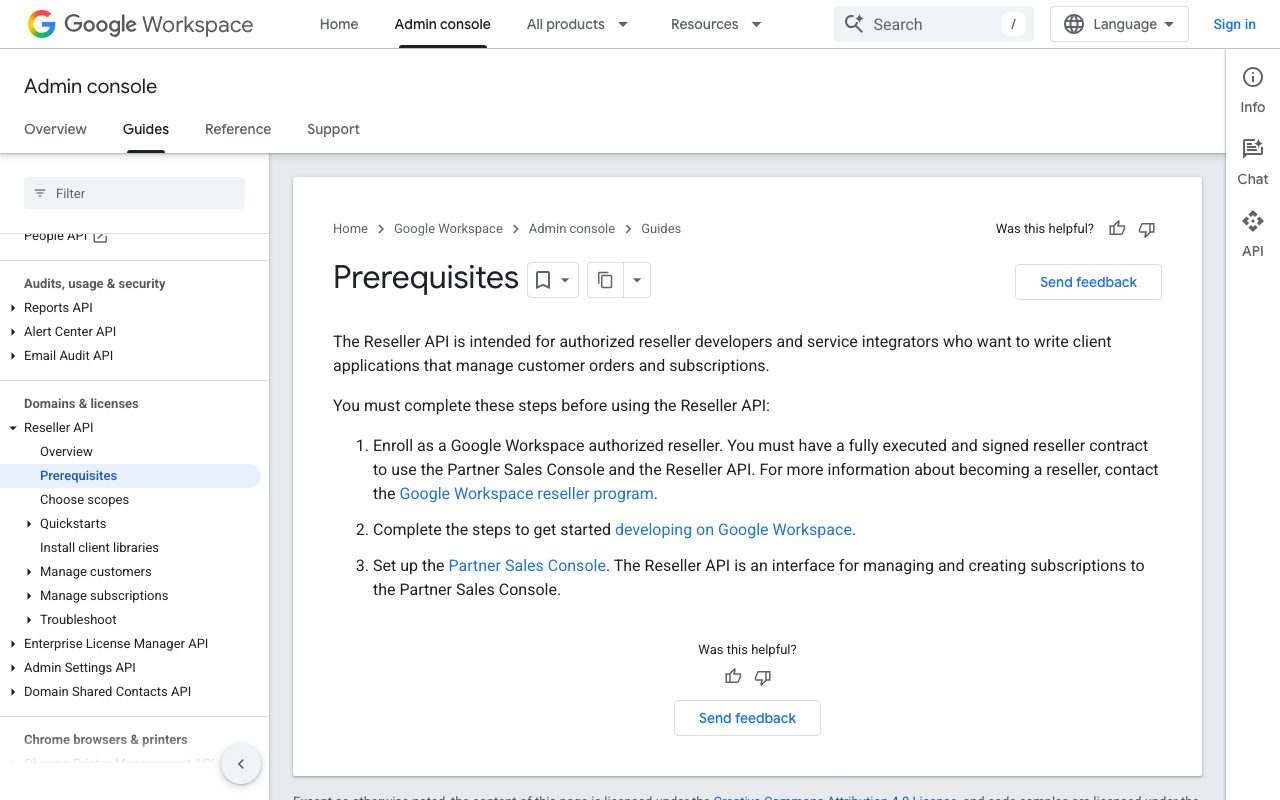
Google requires a signed reseller contract before the Reseller API can be used. Screenshot of developers.google.com, taken on 7 October 2026.
The step-by-step versions are in how to become a Google Workspace reseller and the Microsoft 365 CSP reseller guide.
Price points
At list, the entry tiers of the two suites cost the same on the latest US figures we could source. Note the dates: the Google figures are from January 2025 and the Microsoft figures took effect on 1 July 2026.
| Tier | Google Workspace, annual plan | Google Workspace, flexible plan | Microsoft 365, with Teams | Microsoft 365, no Teams |
|---|---|---|---|---|
| Entry | Business Starter $7 | $8.40 | Business Basic $7.00 | $5.40 |
| Middle | Business Standard $14 | $16.80 | Business Standard $14.00 | $10.79 |
| Upper | Business Plus $22 | $26.40 | Business Premium $22.00 | $18.79 |
Prices are USD per user per month. Google figures: 9to5Google, 15 January 2025. Microsoft figures: Microsoft Licensing, published 16 February 2026.
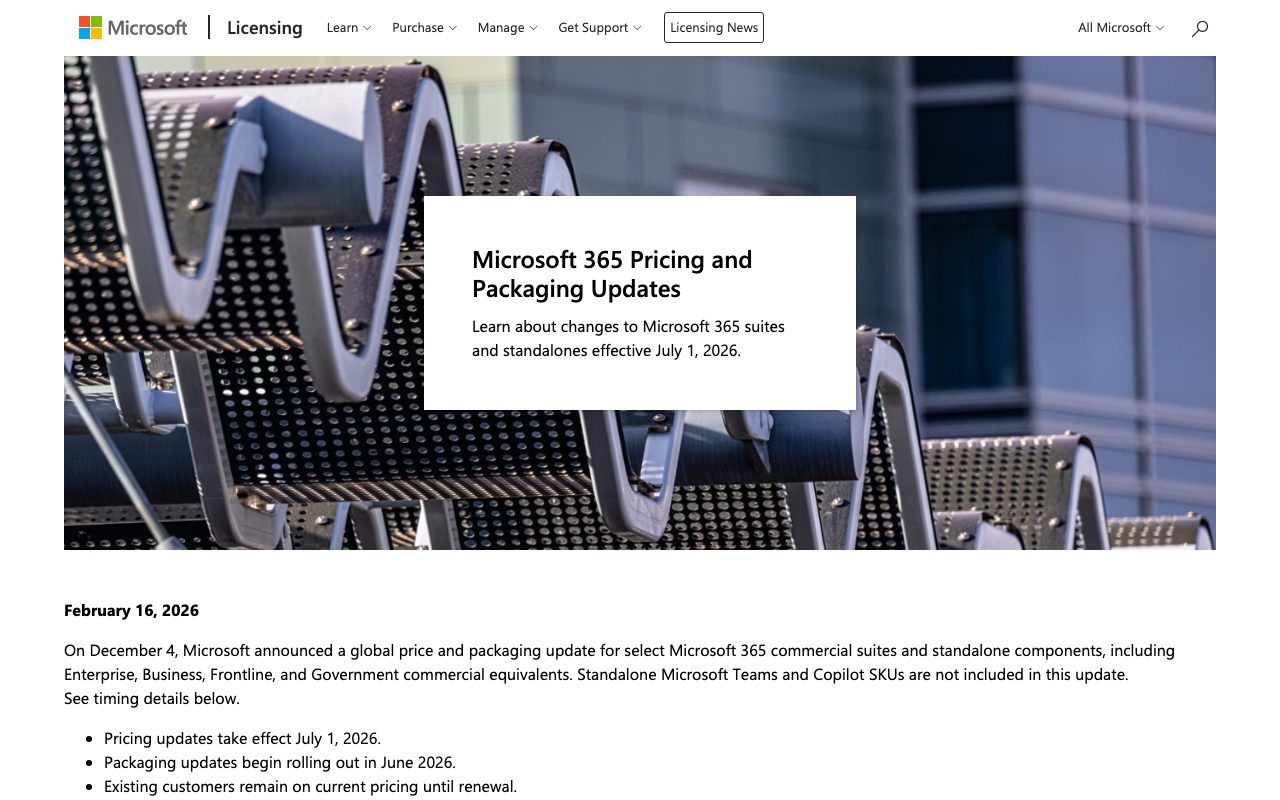
Microsoft announced price and packaging changes for Microsoft 365 that take effect on 1 July 2026. Screenshot of microsoft.com, taken on 7 October 2026.
Three things matter to a reseller here.
- Both vendors raised prices recently. Microsoft moved Business Basic from $6.00 to $7.00 and Business Standard from $12.50 to $14.00 on 1 July 2026, with existing customers moving at renewal. Google moved Starter from $6 to $7 and Standard from $12 to $14 in January 2025. Your retail price list needs a clause that lets you pass increases on.
- Google's line-up has changed since. Google's pricing page, as served to us on 7 October 2026 in Indian rupees, shows Base (maximum 20 users), Starter and Standard (up to 300 users each) and Enterprise, and advertises "Save 16% with 1 year commitment". We could not read current USD prices from it, so treat the Google column as dated.
- Microsoft's no-Teams SKUs are a cheaper floor. That matters if your customer only wants mail.
Margin
Neither vendor publishes what a reseller earns, so no honest comparison can put a percentage on either side.
What is public is the direction. Google's contract says a partner pays the price list less the discount in the Program Guide, and trade press reported that Google cut Workspace renewal discounts by 40% from 1 April 2024. That is a relative cut to a discount whose size is not public, not a 40-point drop.
On the Microsoft side, the distributor Pax8 wrote in July 2026 that the 3.75% baseline incentive on Microsoft 365 for indirect resellers was removed for FY27, while the growth incentive rose from 7.5% to 12.5%. Microsoft also introduced a growth margin on 1 October 2026 for direct bill partners and distributors, with rates in a gated guide. An indirect reseller only sees that if the distributor passes it on, which is worth asking before you sign.
The public signals on both sides point the same way: money for new customers and growth, less for holding renewals. Plain licence resale earns what you add on top, which is the argument for selling licences with domains, setup and support as one package.
Term flexibility
Google's terms are simpler for a reseller. The Reseller API offers an annual commitment paid monthly or yearly, and a flexible plan with no commitment where Google charges for each licence as users are created. On an annual plan you buy a fixed number of licences for the year and add more with a seat change; the docs describe renewal settings for renewing at the current user count, switching to pay as you go or cancelling, and we found no way to cut seats in the middle of an annual term. The no-commitment option cost 20% more than annual on the January 2025 list prices above.
Microsoft's rules are stricter. Licence-based subscriptions get a prorated refund within seven calendar days of purchase, and the window does not reopen until renewal. After that, the partner owes any outstanding amount even if the customer cannot or will not pay. Microsoft's own advice for risky customers is a monthly term or not selling to them. The distributor Pax8 wrote in January 2025 that the monthly term carries a 20% premium, and that annual terms billed monthly carry a 5% premium for new orders and renewals from 1 April 2025. We could not find those two percentages on a Microsoft page.
Google direct partners carry credit risk too: invoices are due net 30, non-refundable, with late interest of 1.5% per month. If you sell either suite on credit, read prepaid wallet billing for resellers first.
API automation
Google's Reseller API is the smaller surface; Microsoft's is broader and had several announced changes in 2026. Google's API creates a customer from a primary domain, an alternate email and an address, then creates a subscription per product, and handles seat changes, renewal settings and transfers in using a customer token that is valid for 30 days.
Microsoft's Partner Center REST API lets partners manage customer accounts, place orders, manage subscriptions and handle support requests, with webhooks for events. It needs upkeep: Microsoft's 2026 announcements list multifactor authentication enforcement for the APIs beginning 1 April 2026, the unbilled invoice reconciliation API v1 retiring on 15 March 2026 and the Check Inventory API retiring on 25 September 2026. We did not check Google's API for comparable changes, so this is not a like-for-like count.
The practical catch is the same on both sides. Google's API needs the signed contract. Indirect Microsoft resellers commonly order through their distributor's portal or API, though we did not find a Microsoft page that states this as a rule. A small reseller usually automates against an intermediary, not against the vendor.
Support burden
You own first-line support either way, but a Microsoft distributor can share some of it. Google's agreement requires a direct partner to use commercially reasonable efforts to resolve customer issues without escalation to Google, including provisioning and billing. Microsoft describes distributors as able to provide indirect resellers with customer support, pricing and billing.
If your customers send a lot of mail, expect tickets about limits. Google Workspace allows 2,000 messages per user per day, and 500 for trial accounts. Exchange Online allows 10,000 recipients per day and 30 messages per minute per mailbox, with a tenant-wide cap on external recipients that scales with licence count. Microsoft's page recommends a separate service for bulk or high-volume mail to external recipients. The detail is in cold email infrastructure: domains and mailboxes.
Customer demand
Only Microsoft publishes a seat count. On its earnings call of 28 January 2026, Microsoft said that paid Microsoft 365 commercial seats grew 6% year over year to over 450 million. We did not find a later seat count.
A comparable Google figure was not found. Google does not publish paid Workspace seats on any page we could open, and the market-share numbers in circulation contradict each other because they count different things. The practical test is your own customer list: sell the suite they already use, because moving a company between suites is a project, not a licence sale.
Where ResellerHQ fits
ResellerHQ is a white-label reseller API that lists Google Workspace and Microsoft 365 licence plans next to domains and phone numbers, paid from one prepaid wallet. In its sandbox you can build and test a licence-ordering flow for plans from both vendors without holding either contract. Sandbox orders use test funds and are not sent to Google or Microsoft.
Mailbox licences run in the sandbox only today: on the live side the routes answer 422 not_available, and there is no live provider for them yet. A licence holds 1 to 300 seats and renews itself every month, charging the wallet and cancelling the licence if it stays unpaid for a week; pro-rated billing and assigning seats to named users are not built. There is no public price list. The docs describe what exists. If you need to sell live seats this quarter, a Microsoft distributor or a Google reseller contract is the route.
Verdict
Start with Microsoft 365 if you are new, serve conventional businesses, or need a programme with published rules. Choose Google Workspace if your customers already use it and you can get a contract or a supplier that has one. Offer both once you have the billing and support to carry two sets of terms. In every case, price on your own markup and services, because neither vendor's baseline margin is public and the public changes since 2024 have favoured growth over renewals.
Questions
- Microsoft 365 is easier to enter. Microsoft lists three requirements for an indirect reseller: partner programme membership, authority to sign agreements, and a relationship with an authorised distributor. Google requires a signed reseller contract, written acceptance into an engagement model and compliance with a Program Guide that is not public.
- Neither vendor publishes a margin. Google's contract says partners pay list price less a discount set in a gated Program Guide, and Microsoft keeps its base margin rates in a gated guide for distributors and direct bill partners. Percentages quoted on blogs are second-hand and should not be planned around.
- Yes. The two programmes are separate and nothing in the pages we read makes them exclusive. In practice that means two contracts, two billing models and two provisioning integrations, or an aggregator that sits in front of both.
- Google's Reseller API is the more compact of the two: customers, subscriptions, seat changes, renewal settings and transfers. Microsoft's Partner Center REST API covers customers, orders, subscriptions and support requests and adds webhooks; Microsoft began enforcing multifactor authentication on it on 1 April 2026 and announced two API retirements during 2026.
- At the entry tiers they were level on the last US figures we could source: USD 7, 14 and 22 per user per month for Google's Business Starter, Standard and Plus on annual plans (January 2025) and for Microsoft 365 Business Basic, Standard and Premium (from 1 July 2026). Check Google's live pricing page, because its plan line-up has changed since.
- The reseller does, on both sides. Microsoft states that the partner is responsible for outstanding amounts even if the customer cannot or will not pay, and Google invoices direct partners on net 30 terms with fees that are non-refundable.
Sources
- Microsoft Learn: Cloud Solution Provider program overview learn.microsoft.com
- Microsoft Learn: Indirect Reseller Eligibility Requirements learn.microsoft.com
- Microsoft Learn: New Commerce Experience Cancellation Policy learn.microsoft.com
- Microsoft Licensing: 2026 Microsoft 365 packaging and pricing updates microsoft.com
- Microsoft Learn: Partner Center REST API reference learn.microsoft.com
- Microsoft Learn: Partner Center announcements learn.microsoft.com
- Microsoft Learn: October 2026 Partner Center announcements learn.microsoft.com
- Microsoft Learn: Exchange Online limits learn.microsoft.com
- Pax8: Microsoft incentives FY27 updates pax8.com
- Pax8: Microsoft CSP New Commerce Experience guide pax8.com
- Microsoft Investor Relations: FY26 second quarter earnings conference call microsoft.com
- Google Workspace: Reseller agreement (North America) workspace.google.com
- Google for Developers: Reseller API prerequisites developers.google.com
- Google for Developers: Reseller API concepts developers.google.com
- Google for Developers: Reseller API, manage subscriptions developers.google.com
- Google Workspace: Pricing workspace.google.com
- Google Workspace: Gmail sending limits knowledge.workspace.google.com
- 9to5Google: Google Workspace price increase 2025 9to5google.com
- Channelnomics: Google irks partners with slashes to Workspace renewal discounts channelnomics.com