Comparisons
ResellerClub alternatives in 2026, compared
Six ResellerClub alternatives compared on pricing model, API, sandbox, white-label and payment terms, using each vendor's own pages as read in October 2026.
The short answer
The main ResellerClub alternatives in 2026 are OpenSRS, Enom, Openprovider, CentralNic Reseller, Namecheap's API and GoDaddy's reseller programme. Openprovider suits buyers who want registry cost plus a flat membership, CentralNic Reseller and Openprovider list the largest TLD catalogues, OpenSRS and GoDaddy have ready-made storefronts, and Namecheap has a low published bar for API access. None is cheaper in every case: the right pick depends on your volume, the endings you sell and whether you want a storefront or an API.
The main alternatives to ResellerClub in 2026 are OpenSRS, Enom, Openprovider, CentralNic Reseller, Namecheap's API and GoDaddy's reseller programme. They differ mainly in how you pay: volume tiers, an annual membership, a storefront subscription, or plain retail pricing with an API on top.
This comparison uses each vendor's own pages, read on 7 October 2026. Where a figure could not be found on a page that was opened, the cell says "not found" instead of guessing.
What ResellerClub offers today
ResellerClub is a prepaid, volume-tiered domain wholesaler with a hosted storefront, and it is the baseline the rest are measured against. Its reseller page says you create a free account, fund it, and can then "start registering domains at wholesale immediately", with .com from $12.39 a year as of October 2026 and wholesale tier pricing that "goes down as your volume grows". The same page lists 500+ TLDs and 100,000+ resellers on its OrderBox platform.
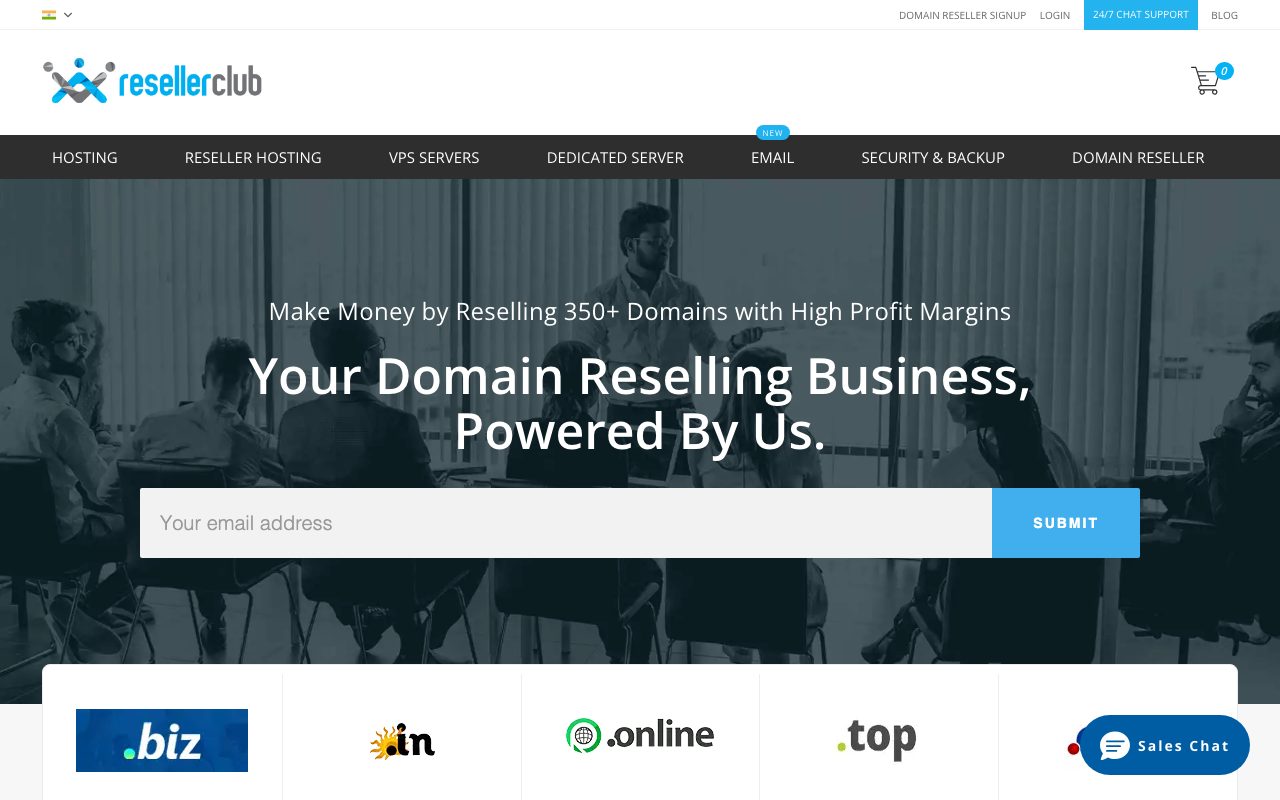
ResellerClub pitches its programme to people starting a domain reselling business. Screenshot of resellerclub.com, taken on 7 October 2026.
It sells through three channels: a hosted branded storefront, a control panel and an API. On the API, read the wording carefully. The API documented today is the HTTP API, which the knowledge base says is free, subject to limits on request volume, and usable only from IP addresses you have registered. The platform page says ResellerClub is "rebuilding the ResellerClub developer experience from the ground up", with a modern REST API, live documentation and instant sandbox keys, and that details will follow in its developer portal. That describes work in progress, so ask what is available on your account before you plan an integration around it.
ResellerClub's pricing page, read on 11 October 2026, states a minimum usable deposit of $25 at the Base Slab, and publishes four slabs by Total Receipts: $25, $499, $1,499 and $2,999.
The floor every platform prices against
A platform that sells .com below the registry fee plus the ICANN fee loses money on the name, so the useful number is the markup above that floor. Verisign's registry-level wholesale fee for .com is $10.26 a year and rises to $10.97 on 1 November 2026, announced on 23 April 2026. ICANN adds $0.20 per domain-year under its fiscal year 2026 fee schedule.
That puts the floor at $10.46 today and $11.17 from November. ResellerClub's "from $12.39" sits $1.93 above today's floor, and the OpenSRS entry tier at $14.50 sits $4.04 above it. Every .com price in this article was captured before the November increase, so each may rise by up to $0.71 if the vendor passes the increase on.
Comparison table
The seven platforms split into four pricing models, and the three that state how you pay for wholesale orders all use a prepaid balance. All cells are as of 7 October 2026 unless a different date is given, and link to the page the fact came from.
| Platform | Pricing model | API | Sandbox | White-label | Payment model |
|---|---|---|---|---|---|
| ResellerClub | Free account, volume tiers; .com from $12.39 | HTTP API today; REST API being rebuilt | Sandbox keys advertised as part of the rebuild | Hosted branded storefront and control panel | Prepaid: fund the account first; $25 usable deposit at the Base Slab, read on 11 October 2026 |
| OpenSRS | Four tiers by annual spend; Essential .com $14.50, no requirements | XML for domains, JSON for email | Test host in the quickstart, no IP whitelisting needed | Storefront, free, $0.75 per order | Wholesale payment terms not found on the pages opened; storefront payouts via Stripe |
| Enom | Four tiers; Advanced needs $2,000 annual spend and 100 registrations; one-time enrolment fee shown as $50 | 300+ commands by query string or POST | Test environment | White-label platform; for a hosted storefront Enom points to its sister brand's OpenSRS Storefront | Prepaid balance, refilled by card, PayPal or ACH/wire |
| Openprovider | Annual membership unlocks cost price; from $4.16 a month billed annually for up to 100 domain operations | REST; old v1beta endpoints switch off 30 June 2027 | Separate sandbox control panel | Hosted storefront not found on the pages opened | Prepaid balance with auto top-up |
| Namecheap | Retail registrar pricing; no domain wholesale tier found, and the reseller page covers SSL | XML API; 50 calls a minute | Separate sandbox account | Hosted domain storefront not found; you build your own front end on the API | Payment terms for API orders not found; API access needs 20 domains, $50 balance or $50 spent |
| GoDaddy reseller | Subscription: Basic renews at $107.88 a year, Pro at $179.88; buy rates up to 20% or 40% off retail | Turnkey plans cannot use the APIs; a separate API Reseller plan, offered to select businesses, can | Not found; the quickstart says all requests go to production | White-label storefront | Turnkey: GoDaddy charges the customer and pays monthly commission |
| CentralNic Reseller | Volume and commitment tiers; prices not published on the page | Seven gateways including REST, EPP and SOAP | OT&E test system | Sub-reseller system with white-label | Not found on the pages opened |
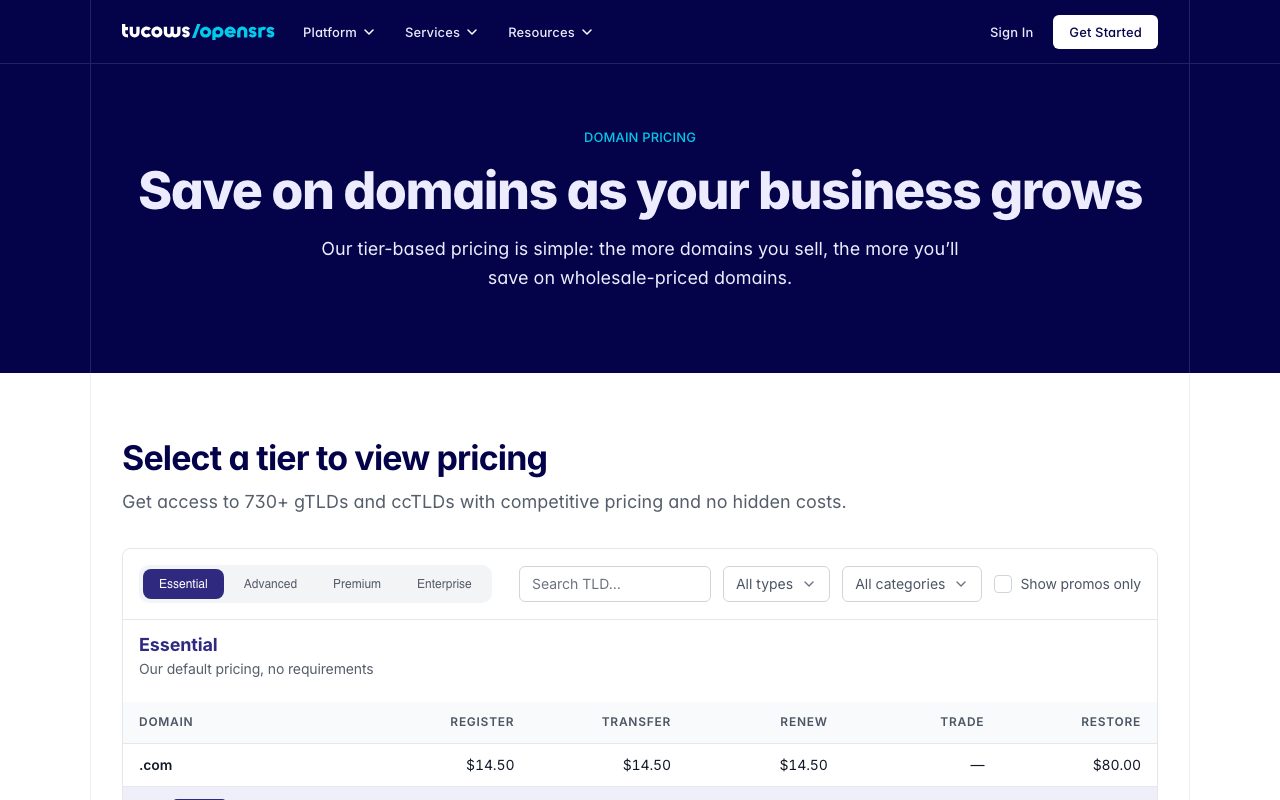
OpenSRS publishes its wholesale prices by tier; the default Essential tier lists .com at $14.50. Screenshot of opensrs.com, taken on 7 October 2026.
Two cautions on reading it. TLD counts are not comparable between vendors, because some count second-level endings and some do not. And a "from" price is a best case: your price depends on the tier you land in.
Which alternative fits which reseller
Each alternative is strongest for a different kind of buyer, so start from your volume and your sales channel, not from the headline .com price.
OpenSRS: one account for domains, email and SSL
OpenSRS fits when you want a ready storefront and several product lines from one supplier. Its pricing page lists 730+ TLDs and 13,000+ resellers supporting 14 million domains, and spend across email, domains and SSL counts towards your tier. The storefront is free with a $0.75 fee per order, which matters on a single-domain sale.
The trade-offs are the entry price and the API style. The Essential tier .com is $14.50 (read on 11 October 2026, with $15.25 scheduled from 1 November 2026), the highest of the published entry prices found for this comparison, and the domains API is XML-based. Your tier is "reassessed" at the end of each calendar year, so a slow year can move you to a higher-priced tier.
Enom: the same family, a command-style API
Enom is OpenSRS's sister brand, both part of Tucows, and suits resellers who want a command-style API with 300+ commands. It reports 6.5 million+ domains, 22,000+ resellers and 550+ TLDs. Tier thresholds are published: Advanced needs $2,000 annual spend and 100 registrations or transfers, Premium $50,000 and 500, Enterprise $100,000 and 1,000.
Two details to check before signing up. The pricing page shows a one-time enrolment fee, displayed as $195 reduced to $50. And Enom's FAQ still names the plans Silver, Gold, Platinum and Platinum+, which does not match the pricing page, so confirm which scheme applies to you.
Openprovider: registry cost plus a membership
Openprovider prices differently from the rest: its charge is a flat membership fee, not a markup per domain. Its membership page says members get "over 1,200 TLDs at the same price we pay". As of October 2026 the entry plan, Basic S, costs $4.16 a month billed annually, about $50 a year, and covers up to 100 domain operations. Spread over 100 names that is roughly $0.50 each on top of cost. The next plan, Basic M, is $16.66 a month for up to 500 operations.
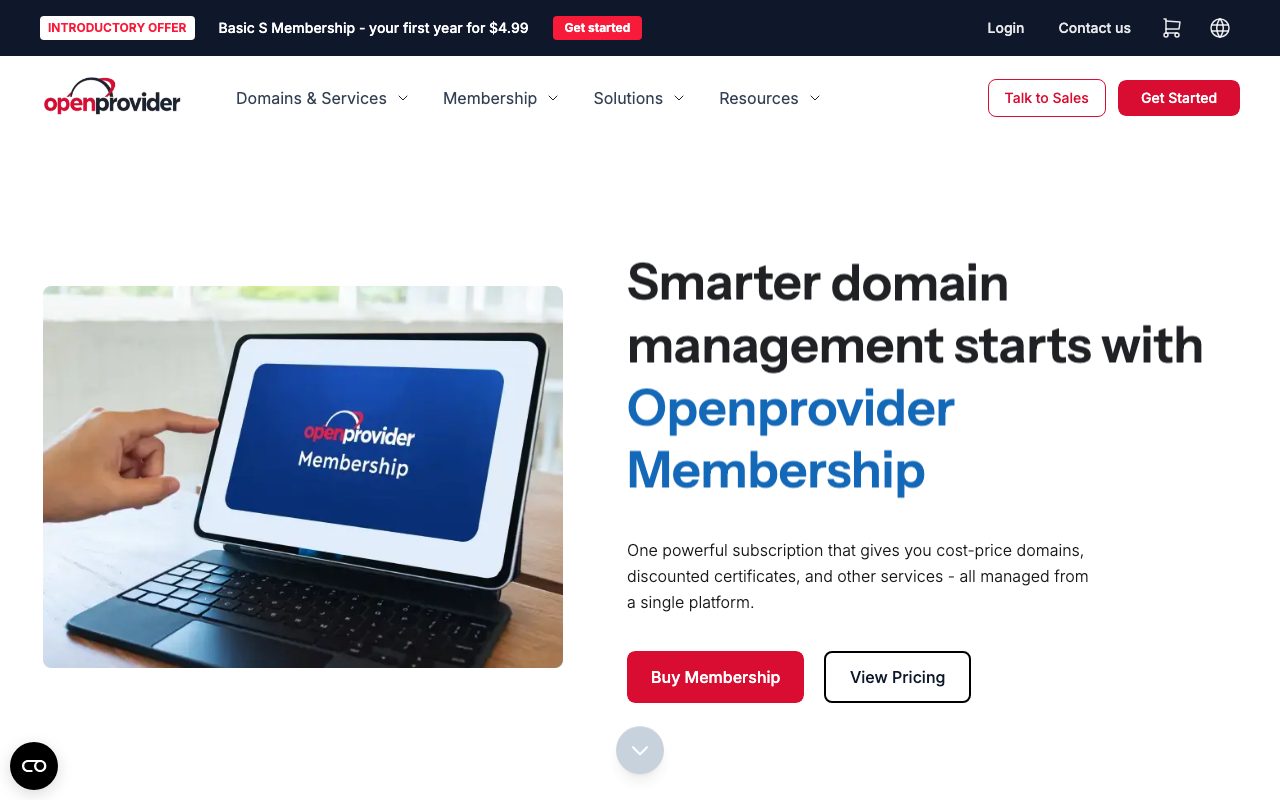
Openprovider sells a membership that gives access to domains at cost price. Screenshot of openprovider.com, taken on 7 October 2026.
The catch is that the fee is fixed. If your volume drops, the cost per name rises, and without a membership the page offers the catalogue at retail rates. The balance is prepaid and also pays the membership fee.
CentralNic Reseller: breadth and protocols
CentralNic Reseller lists the largest catalogue and the most API gateways in this comparison. Its programme page lists 1,900+ TLDs and SLDs and seven API gateways, including EPP for teams that already speak registry protocols. The page says new resellers start on "an entry tier with full API access".
What it does not do is publish prices or deposit terms on the pages opened for this article. Expect to ask its sales team for both.
Namecheap: a low bar to an API
Namecheap is a retail registrar with an API, not a wholesale programme, and no domain wholesale tier was found. Production API access needs one of three things: 20 domains in the account, a $50 balance, or $50 spent in the last two years. The API returns XML and is capped at 50 calls a minute, 700 an hour and 8,000 a day. No hosted domain storefront was found, so the brand layer is yours to build.
GoDaddy reseller: a storefront without a merchant account
GoDaddy's turnkey programme suits someone who wants a ready-made shop and no payment setup of their own. Both plans include a white-label storefront and card processing, and GoDaddy says there is "no need to establish your own merchant account". The cost is a subscription plus a discount off retail in place of a wholesale price list: as of October 2026 Basic renews at $107.88 a year with buy rates "up to 20% off retail", and Pro at $179.88 with "up to 40% off retail". If you sell at GoDaddy's retail price, those discounts are the most you can keep. Turnkey plans cannot use the APIs; that needs the separate API Reseller plan, which the same page says is available to select businesses.
What reviews say, and how far to trust them
Trustpilot scores vary widely between these brands, and the low-scoring pages are dominated by complaints about support. On Trustpilot on 11 October 2026, ResellerClub scored 4.7 out of 5 from around 1,500 reviews, Openprovider 3.6 from around 90, OpenSRS 1.7 from around 20 and Enom 1.2 from around 100.
Treat these as signals only. The samples for the wholesale brands are small, they include end customers of resellers, and unhappy users post more often. No review data was opened for Namecheap's API, GoDaddy's reseller plans or CentralNic Reseller.
How to switch without breaking anything
A registrar transfer on its own should not take a site offline, as long as the nameservers do not change. Openprovider's migration guide, published 17 February 2026, says a transfer "typically does not cause downtime if nameservers remain the same". It is a competitor's guide, but the advice is standard:
- Audit the portfolio first: lock status, authorisation codes and contact email accuracy.
- Avoid transferring names that are close to their renewal date. The guide says renewal behaviour on transfer varies by TLD.
- Move a small, low-risk batch before the rest.
- Leave DNS where it is until the transfers have settled.
If you are integrating by API, compare the things marketing tables skip: idempotency, webhooks, rate limits and error semantics. Our domain reseller API comparison covers those, and prepaid wallet billing for resellers explains what happens when a renewal meets an empty balance.
Where ResellerHQ fits
ResellerHQ is not a replacement for ResellerClub today, and it would be wrong to list it as one. Domains on ResellerHQ run in the sandbox only: live domain routes answer 422 not_available, sandbox domains are not registered anywhere, and DNS management, transfers and automatic domain renewal are not built yet. There is no published price list, and there are no customers or benchmarks to point to. Every platform above registers real names now, and each of the wholesale ones lists hundreds or thousands of endings. On both points they are ahead.
Where it differs is scope and API design. ResellerHQ puts phone numbers that receive SMS, domains and mailbox licences for Google Workspace and Microsoft 365 behind one prepaid wallet and one REST API, with idempotency keys on purchases and signed webhooks. Of the three, only phone numbers can be ordered live, and that depends on an upstream provider. If you are planning a product that sells all three, you can sign up and test the integration in the sandbox with test funds, without a card, and decide later. If you need to register domains for paying customers this month, pick one of the platforms in the table. For the wider plan, see how to start a domain and email reselling business.
The short version
- Flat membership fee in place of a per-domain markup: Openprovider, which pays off if the fee is spread over enough names.
- Largest listed catalogue and most API gateways: CentralNic Reseller.
- Storefront plus email and SSL: OpenSRS.
- Storefront with payments handled for you: GoDaddy turnkey.
- Low published bar to API access for a small account: Namecheap.
- Staying put is also reasonable: ResellerClub has a free account, a published .com price and a hosted storefront, and says it is rebuilding its API.
Questions
- It depends on what you are leaving for. Openprovider fits if you want registry cost plus a flat membership fee, CentralNic Reseller if you need a very wide TLD catalogue and several API protocols, OpenSRS if you want a hosted storefront with domains, email and SSL, and Namecheap if you only need an API with a low published entry bar.
- ResellerClub says a reseller account is free and that you can register domains at wholesale once you fund the account. Its page lists .com from $12.39 a year as of October 2026, and its [pricing page](https://www.resellerclub.com/pricing) states a minimum usable deposit of $25 at the Base Slab, read on 11 October 2026.
- On the vendors' own pages as of October 2026, CentralNic Reseller lists 1,900+ TLDs and SLDs, Openprovider lists over 1,200 on its membership page, OpenSRS lists 730+, Enom 550+ and ResellerClub 500+. Vendors count differently, so check the specific endings you sell.
- No. A reseller sells through a platform that holds or sits on a registrar accreditation. Accreditation itself carries a $4,000 annual ICANN fee plus a $0.20 fee on each domain-year, according to ICANN's fiscal year 2026 fee schedule.
- Not normally. Openprovider's migration guide says a registrar transfer alone typically does not cause downtime if the nameservers stay the same, and advises against transferring names that are close to expiry because renewal behaviour on transfer varies by TLD.
- The ones that state a payment model mostly use a prepaid balance: ResellerClub, Enom and Openprovider all describe funding an account before buying. GoDaddy's turnkey plans are the exception in shape, because GoDaddy charges the end customer's card and pays the reseller commission. No public postpaid offer for new resellers was found on the pages opened in October 2026.
Sources
- ResellerClub: Domain reseller programme resellerclub.com
- ResellerClub: Pricing resellerclub.com
- ResellerClub: Platform and API overview resellerclub.com
- ResellerClub: HTTP API knowledge base article manage.resellerclub.com
- OpenSRS: Domain pricing opensrs.com
- OpenSRS: API overview opensrs.com
- OpenSRS: Storefront overview opensrs.com
- Enom: Domain reseller pricing plans enom.com
- Enom: Reseller API enom.com
- Enom: Sell domain names FAQ enom.com
- Enom: Reseller programme enom.com
- Enom: OpenSRS Storefront enom.com
- Openprovider: Membership plans openprovider.com
- Openprovider: Prepaid system openprovider.com
- Openprovider: API documentation docs.openprovider.com
- Openprovider: How to enable API access support.openprovider.eu
- Openprovider: Choosing the right ResellerClub alternative openprovider.com
- Namecheap: API introduction namecheap.com
- Namecheap: API FAQ namecheap.com
- Namecheap: Reseller programme namecheap.com
- GoDaddy: Reseller programme godaddy.com
- GoDaddy: How do API Reseller and Turnkey Reseller plans differ godaddy.com
- GoDaddy: Developer portal, get started developer.godaddy.com
- CentralNic Reseller: Domain reseller programme centralnicreseller.com
- CentralNic Reseller: API centralnicreseller.com
- Verisign: First quarter 2026 results investor.verisign.com
- ICANN: Registrar-level fees for fiscal year 2026 icann.org
- Trustpilot: ResellerClub reviews trustpilot.com
- Trustpilot: OpenSRS reviews trustpilot.com
- Trustpilot: Enom reviews trustpilot.com
- Trustpilot: Openprovider reviews trustpilot.com