Guides
How to start a domain and email reselling business
Open a wholesale domain account, add Google Workspace or Microsoft 365 through a distributor, price for renewals, and earn your margin on service.
The short answer
To start a domain and email reselling business, open a prepaid wholesale account with a registrar reseller programme, add Google Workspace or Microsoft 365 licences through a distributor or a platform that already holds the vendor contract, and bill customers under your own brand. Domains alone earn a few dollars a year each, so the profit comes from bundling email seats and a service fee and from keeping renewals. You do not need ICANN accreditation, but you do need working capital for prepaid deposits and licence term commitments.
To start a domain and email reselling business, open a prepaid wholesale account with a registrar reseller programme, add Google Workspace or Microsoft 365 licences through a distributor or a platform that already holds the vendor contract, and bill your customers under your own brand. The domain is the entry product and earns a few dollars a year; the money is in the email seats, the service fee you attach to them, and the renewals.
The rest of this guide is the plan: how big the market is, what to sell, where the margin sits, where to buy, how to price, and what goes wrong. All prices were read on 7 October 2026 unless a different date is given.
How big is the market?
The market is large and still growing: 401.6 million domain names were registered at the end of June 2026, up 8.1% year on year, according to the Verisign Domain Name Industry Brief published 23 July 2026. Of those, 166.6 million were .com names (DNIB Q2 2026).
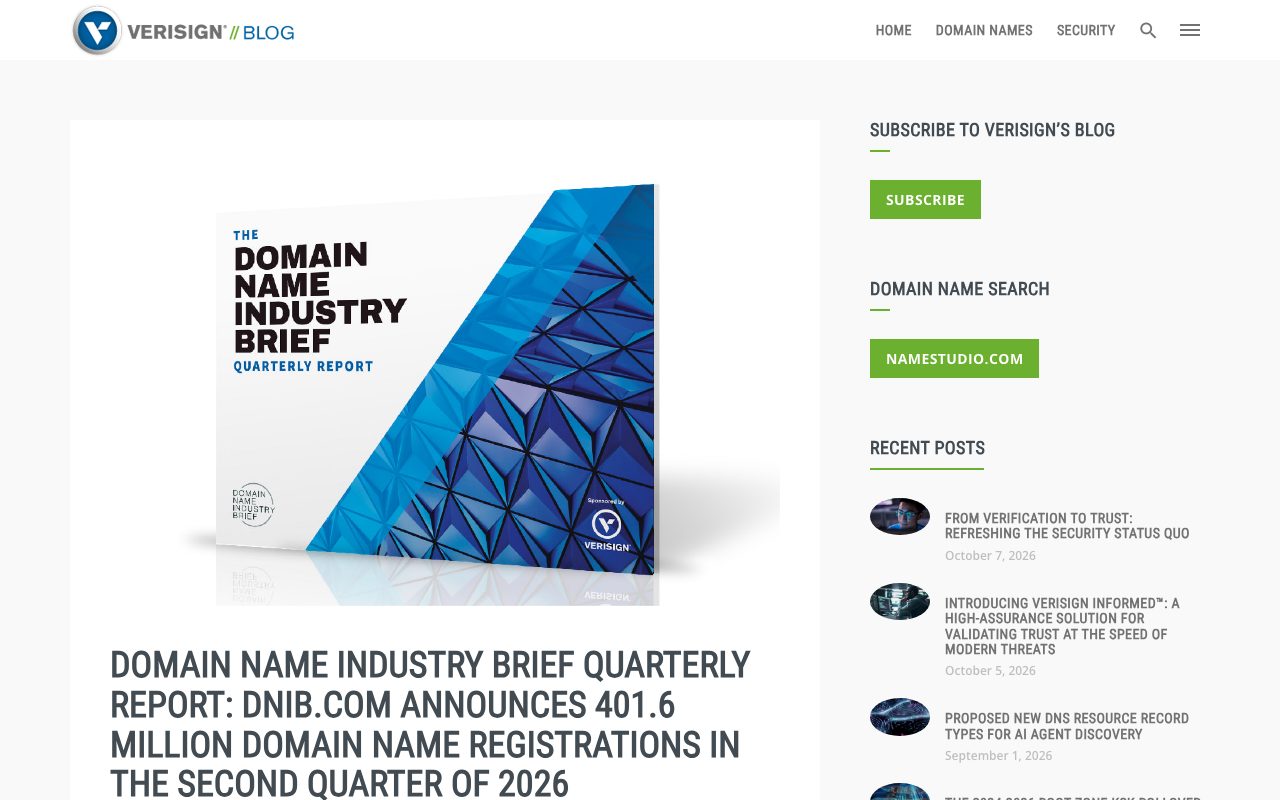
The Domain Name Industry Brief reported 401.6 million domain name registrations for the second quarter of 2026. Screenshot of blog.verisign.com, taken on 7 October 2026.
On the email side, Microsoft reported more than 450 million paid commercial Microsoft 365 seats in January 2026, growing 6% year on year (Office 365 for IT Pros, reporting Microsoft's FY26 Q2 results). Google does not publish a paid seat count for Workspace, so no comparable figure is given here.
Two caveats. First, a dollar figure for the reseller channel as a whole was not found in any primary source. The closest hard number is one wholesaler: Tucows, which runs OpenSRS and Enom, reported $48.8 million of wholesale domain services revenue for the quarter ended 30 June 2026 (Tucows 10-Q). Second, a growing market does not mean growing reseller margins, as the sections below show.
What should you sell?
Sell a bundle of three things: the domain, the email seats on it, and the work of setting both up and keeping them running. Each plays a different role.
- Domains. Low price, low margin, renewed yearly. They give you the customer relationship and control of DNS, which everything else depends on.
- Email licences. Google Workspace or Microsoft 365 seats, billed per user per month. This is where the revenue volume is. For the differences between the two programmes, see Google Workspace vs Microsoft 365 for resellers.
- Service. Setup, DNS records, migration, user changes and first-line support. This is the part you fully price yourself.
Add-ons such as SSL certificates and premium DNS are a common fourth line. Openprovider, a wholesaler, claims these carry 40 to 70% margins against about 15% on domains alone (Openprovider). That is a vendor estimate, not a measured benchmark.
Where is the margin?
The margin is in your markup and service fee, not in programme discounts, which are thin on domains and unpublished or shrinking on licences.
Domains have a hard floor. Verisign charges registrars $10.26 a year per .com name, rising to $10.97 on 1 November 2026 (Verisign Q1 2026 results). ICANN adds $0.20 for each year of a registration, renewal or transfer (ICANN FY26 fees). So the floor moves from $10.46 to $11.17, and your wholesaler's margin sits on top of that before yours does.
Licence discounts are not public. Google's reseller agreement says the partner pays "the price stated on the applicable Price List, less the applicable discount stated in the Program Guide", and the Program Guide is gated (Google reseller agreement). Google cut Workspace renewal discounts by 40% from 1 April 2024, with the before and after percentages not published (Channelnomics, 2 April 2024). On the Microsoft side, the 3.75% core incentive for indirect resellers on Microsoft 365 was removed on 1 July 2026, with a growth-based incentive raised instead, as reported by the distributor Pax8 (Pax8, 28 July 2026).
No independent survey of reseller margins was found. CentralNic Reseller, another wholesaler, puts it bluntly: "There's no universal margin number, and anyone offering one is selling something" (CentralNic Reseller, 11 September 2026).
Where do you buy domains at wholesale?
You buy from an accredited registrar's reseller programme, and almost all of them work on a prepaid balance. The table shows what each publishes. A blank is stated as "not published" or "not found" rather than guessed.
| Programme | Cost to start | Published .com price | How you pay | Best at |
|---|---|---|---|---|
| OpenSRS | One-time $95 activation fee (payment terms) | $14.50 on the default Essential tier | Prepaid deposit; 3% fee on card or PayPal deposits | Wholesale platform that also sells email boxes and certificates, with an optional storefront |
| ResellerClub | Free account; $25 fully usable deposit at the Base Slab | From $12.39 | Prepaid | White-label storefront and 500+ endings; wholesale tiers step down with volume |
| Openprovider | Membership from $4.16 a month, billed annually | Registry cost for members; effective cost stated as $10.46, rising to $11.18 on 1 November 2026, in a post dated 9 September 2026 (Openprovider) | Prepaid balance | Registry-cost pricing once you have enough names to cover the membership |
| GoDaddy | $53.88 (Basic) or $89.88 (Pro) for the first year | Not published; up to 20% or 40% off retail | GoDaddy's merchant account processes your customers' payments | Storefront with payment processing and white-label customer support included |
| Name.com | "No fees, no application, no sales call" | Not published | Account credit | Developers who want a REST API with no programme paperwork |
| NameSilo | Free; $50 prepaid to join the discount programme | $17.29 list; $11.05 in the discount programme | Prepaid for discounted prices | Published prices at every volume level |
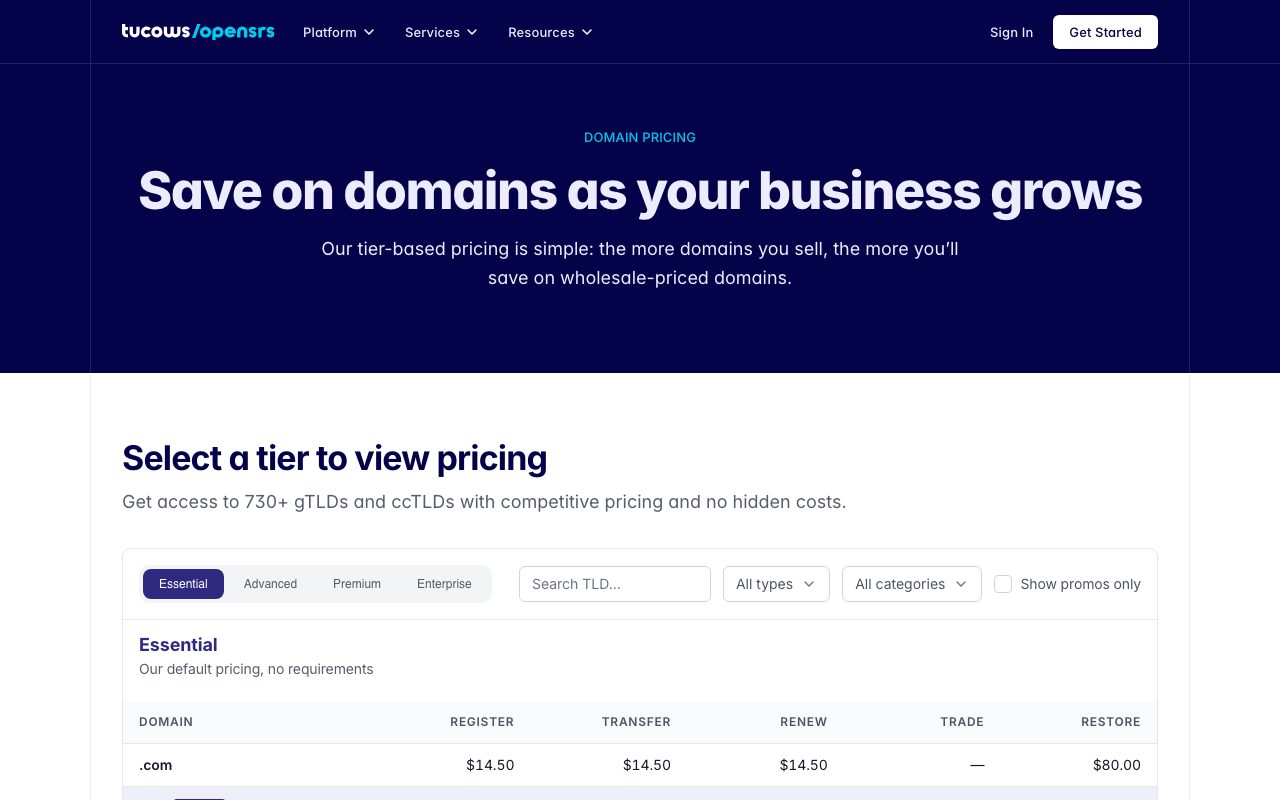
OpenSRS publishes its wholesale prices by tier; the default Essential tier lists .com at $14.50. Screenshot of opensrs.com, taken on 7 October 2026.
For a deeper look at these and others, see ResellerClub alternatives and the domain reseller API comparison.
You do not need your own ICANN accreditation. ICANN charges $4,000 per registrar accreditation per year (ICANN), and Openprovider cites a further $3,500 application fee and $70,000 in liquid capital (Openprovider). That is a later-stage decision.
How do you get the right to resell email licences?
You get it through a vendor programme, and for a new business that usually means going through someone who already has the contract.
Microsoft 365. A new reseller joins the Cloud Solution Provider programme as an indirect reseller, which requires an active Microsoft AI Cloud Partner Program membership, authority to sign agreements, and "a partnership with an authorized distributor". Buying direct from Microsoft requires 12 months as an indirect reseller and at least USD 1 million in trailing twelve-month CSP revenue (Microsoft Learn, updated June 2026). The steps are in the Microsoft 365 CSP reseller guide.
Google Workspace. Resale rights depend on a signed product schedule, written acceptance into an engagement model, and meeting the Program Guide requirements. Google invoices the partner on net 30 terms, fees are non-refundable, and the partner handles first-line support (Google reseller agreement). See how to become a Google Workspace reseller.
How should you price your packages?
Price the bundle per seat per month, with the domain included or itemised yearly, and set the price on what a renewal year earns you rather than the first year. For the difference between a markup and a margin, and when to run one price for everyone against a price list by customer type or a price agreed with one account, see how to price reseller services.
Three rules follow from the sourced numbers:
- Price for renewals. The combined .com and .net renewal rate was 75.2% in Q2 2026, while new gTLDs renewed at about 31.0% (DNIB Q2 2026). A cheap first year on a novelty ending mostly buys a customer who leaves.
- Charge more for flexibility. Google's own January 2025 US list prices put flexible plans 20% above annual ones, for example Business Starter at $8.40 against $7 (9to5Google, 15 January 2025). Mirror that: a customer who wants to drop seats any month should pay for the option.
- Keep the service fee visible. Vendor list prices are public. Microsoft 365 Business Basic went from $6 to $7 per user per month on 1 July 2026 (Microsoft Licensing). Customers can look that up, so a markup hidden in the seat price is harder to defend than a named management fee.
A worked example (illustration only)
This is an illustration built from published list prices and one stated assumption. It is not a benchmark, a forecast or anyone's actual results.
Assume 50 small-business customers, each with one .com and five Microsoft 365 Business Basic seats. Domains are bought at ResellerClub's published from-price of $12.39 and sold at $17.29, which is NameSilo's public list price and stands in here for a typical retail price. The management fee of $3 per seat per month is an assumption chosen for the arithmetic.
| Line | Calculation | Per year |
|---|---|---|
| Domain revenue | 50 x $17.29 | $864.50 |
| Domain cost | 50 x $12.39 | $619.50 |
| Domain gross margin | 50 x $4.90 | $245.00 |
| Domain gross margin if a $0.71 rise is passed on and retail stays put | 50 x $4.19 | $209.50 |
| Licence billings at list | 250 seats x $7 x 12 | $21,000.00 |
| Licence margin per percentage point of discount you obtain | 1% of $21,000 | $210.00 |
| Management fee (assumed) | 250 seats x $3 x 12 | $9,000.00 |
Two things stand out. A single percentage point of licence discount is worth almost as much as the whole domain book, and the assumed service fee is worth far more than both. The same domains bought at OpenSRS's Essential price of $14.50 (read on 11 October 2026) would leave $2.79 each, or $139.50, before a 3% card deposit fee (OpenSRS).
How do billing and support work?
You carry the float and the first-line support, so plan cash and time for both. Wholesale domain accounts are prepaid: OpenSRS requires a deposit before any registration and recommends holding at least one month of spend in advance (OpenSRS). Licences run the other way, with term commitments you owe whether or not your customer pays.
Microsoft gives a prorated refund on licence-based subscriptions only within seven calendar days of purchase, and says the partner "is responsible for payment of any outstanding amounts regardless of whether the customer can't pay or refuses to pay" (Microsoft Learn). In the example above, 250 seats on an annual term is $21,000 of exposure at list price. Google's Reseller API documentation says a flexible plan can be moved to an annual commitment but not the reverse: "You can't update an annual commitment plan" (Google for Developers, updated 3 September 2026).
The practical setup is to collect from customers in advance, by card or direct debit, before you commit upstream. The mechanics of running that on a balance are covered in prepaid wallet billing for resellers. If you would rather not handle payments at all, GoDaddy's programme processes customer payments through its own merchant account and offers white-label support (GoDaddy), at the cost of a discount-off-retail model rather than a wholesale price.
Billing itself is a separate decision from how you fund it: whether you invoice a customer the moment they buy something or gather everyone's purchases into one bill a month, and what a reseller invoice needs to show, is covered in how to invoice your reseller customers.
Which mistakes eat the margin?
Most lost margin comes from a short list of avoidable errors.
- Ignoring the .com increase. The $0.71 registry rise on 1 November 2026 is about 14% of the $4.90 margin in the example. Reprice renewals before it lands.
- Funding deposits by card. A 3% deposit fee (OpenSRS) on a $14.50 name is about $0.44, a meaningful slice of a $2.79 margin. OpenSRS states no fee of its own on a standard wire transfer.
- Per-order storefront fees on single domains. OpenSRS Storefront charges $0.75 per order (OpenSRS), which is fine on a bundle and painful on one name.
- An empty balance at renewal. Openprovider advises setting an auto top-up threshold "above the price of the most expensive product or domain renewal in your portfolio" (Openprovider). A lapsed customer domain costs far more in support and goodwill than the float.
- Annual terms for shaky customers. Microsoft's own advice for risky customers is a monthly term or "not selling to that customer" (Microsoft Learn).
- Planning on a programme margin. Discounts are gated and have been cut twice in the sources above. Build the plan on your fee.
Where ResellerHQ fits
ResellerHQ is a white-label reseller API with one prepaid wallet for phone numbers, domains and mailbox licences (Google Workspace and Microsoft 365 seats, not the mailboxes themselves). Its limits today are real: domains and mailbox licences can be ordered in the sandbox only, and the live routes answer 422 not_available. Live phone numbers depend on an upstream provider. ResellerHQ publishes no price list, so it does not appear in the table above, and you cannot run a live domain and email business on it yet.
Where it fits now is building and testing the integration: search, register, renew, buy seats and receive signed webhooks against test funds. Sandbox domains are not registered anywhere and sandbox licences are not provisioned with Google or Microsoft. DNS record management, domain transfers and automatic licence renewal are not part of the API yet. The docs describe what is and is not built, and signup creates an account with a sandbox. If you need to sell real domains this month, use one of the programmes in the table.
Questions
- Entry costs published by wholesale programmes on 7 October 2026 ranged from nothing (Name.com, ResellerClub account) to a one-time $95 activation fee at OpenSRS and $53.88 for the first year of GoDaddy's Basic Reseller plan. On top of that you need a prepaid balance large enough to cover registrations and renewals, because almost every programme debits a deposit rather than invoicing you.
- On domains alone the margin is thin. Buying .com at ResellerClub's published from-price of $12.39 and selling at $17.29 leaves $4.90 a year per name, and no independent benchmark for reseller margins was found. Resellers who make real money bundle email seats, DNS, setup and support on top of the domain.
- No. A reseller registers names through an accredited registrar's wholesale programme, and the registrar holds the accreditation. Accreditation itself carries a $4,000 annual ICANN fee per registrar, so it only makes sense at large volume.
- Yes, but through different programmes. Microsoft 365 is sold through the Cloud Solution Provider programme, where a new reseller must work with an authorised distributor, and Google Workspace requires a signed reseller agreement and acceptance into an engagement model. Many small resellers use a distributor or platform that already holds those contracts.
- Neither vendor publishes it. Google's public reseller agreement says the partner pays list price less a discount set in a gated Program Guide, and no public Microsoft page stating base margin rates was found. Plan your business on your own markup and service fee, not on a programme percentage you cannot verify.
- You are. Microsoft states that the partner is responsible for outstanding amounts even if the customer cannot or will not pay, and Google invoices the partner on net 30 terms with fees that are non-refundable.
Sources
- Verisign: Q2 2026 Domain Name Industry Brief quarterly report blog.verisign.com
- DNIB: The Domain Name Industry Brief Q2 2026 dnib.com
- Verisign: First quarter 2026 results investor.verisign.com
- ICANN: Accredited registrars approve registrar-level fees for fiscal year 2026 icann.org
- Tucows: Form 10-Q for the quarter ended 30 June 2026 sec.gov
- Office 365 for IT Pros: Microsoft FY26 Q2 results office365itpros.com
- OpenSRS: Domain pricing opensrs.com
- OpenSRS: Payment terms opensrs.com
- OpenSRS: Storefront overview opensrs.com
- ResellerClub: Domain reseller programme resellerclub.com
- ResellerClub: Pricing resellerclub.com
- Openprovider: Membership plans openprovider.com
- Openprovider: The .com price increase for domain resellers openprovider.com
- Openprovider: Best domain reseller program openprovider.com
- Openprovider: Prepaid system openprovider.com
- GoDaddy: Reseller programme godaddy.com
- Name.com: Reseller API name.com
- NameSilo: Pricing namesilo.com
- NameSilo: Discount programme namesilo.com
- CentralNic Reseller: Pricing strategies every domain reseller should know centralnicreseller.com
- Microsoft Learn: Cloud Solution Provider programme overview learn.microsoft.com
- Microsoft Learn: New commerce cancellation policy learn.microsoft.com
- Pax8: Microsoft incentives FY27 updates pax8.com
- Microsoft Licensing: Microsoft 365 pricing and packaging updates microsoft.com
- Google Workspace: Reseller agreement, North America workspace.google.com
- Google for Developers: Reseller API, manage subscriptions developers.google.com
- 9to5Google: Google Workspace price increase 2025 9to5google.com
- Channelnomics: Google irks partners with slashes to Workspace renewal discounts channelnomics.com