Comparisons
Twilio alternatives for reselling phone numbers
Telnyx, Plivo, Sinch, Vonage and Bandwidth all separate numbers per customer. Only Telnyx and Vonage document customer balances; none publish reseller margins.
The short answer
The main Twilio alternatives for reselling numbers are Telnyx, Plivo, Sinch, Vonage and Bandwidth. All of them give you a per-customer container, but in most the usage is billed to your one parent account, so customer billing, markup and compliance stay your job. If your customers only need numbers that receive SMS, a reseller platform with a prepaid wallet removes most of that work, at the cost of features.
The realistic Twilio alternatives for reselling phone numbers are Telnyx, Plivo, Sinch, Vonage and Bandwidth, and each has some way to keep one customer's numbers apart from another's. They differ in who gets the bill: Twilio, Plivo and Sinch charge everything to your parent account, while Telnyx and Vonage can also give a customer its own balance.
Most "Twilio alternatives" lists compare outbound SMS prices. A reseller needs different answers: how customers are separated, where the money sits, how much room there is to mark up, and who carries the compliance work. This article takes those in turn, using the vendors' own documentation and pricing pages as opened on 7 October 2026.
What reselling numbers on Twilio involves
Twilio supports reselling through subaccounts, with every charge landing on your main account. Its documentation says a subaccount lets you "segment each of your customers' use of Twilio", that a main account can have up to 1,000 subaccounts by default, and that "Twilio bills all subaccount usage directly to your main account" with one balance for all of them (Twilio subaccounts docs).
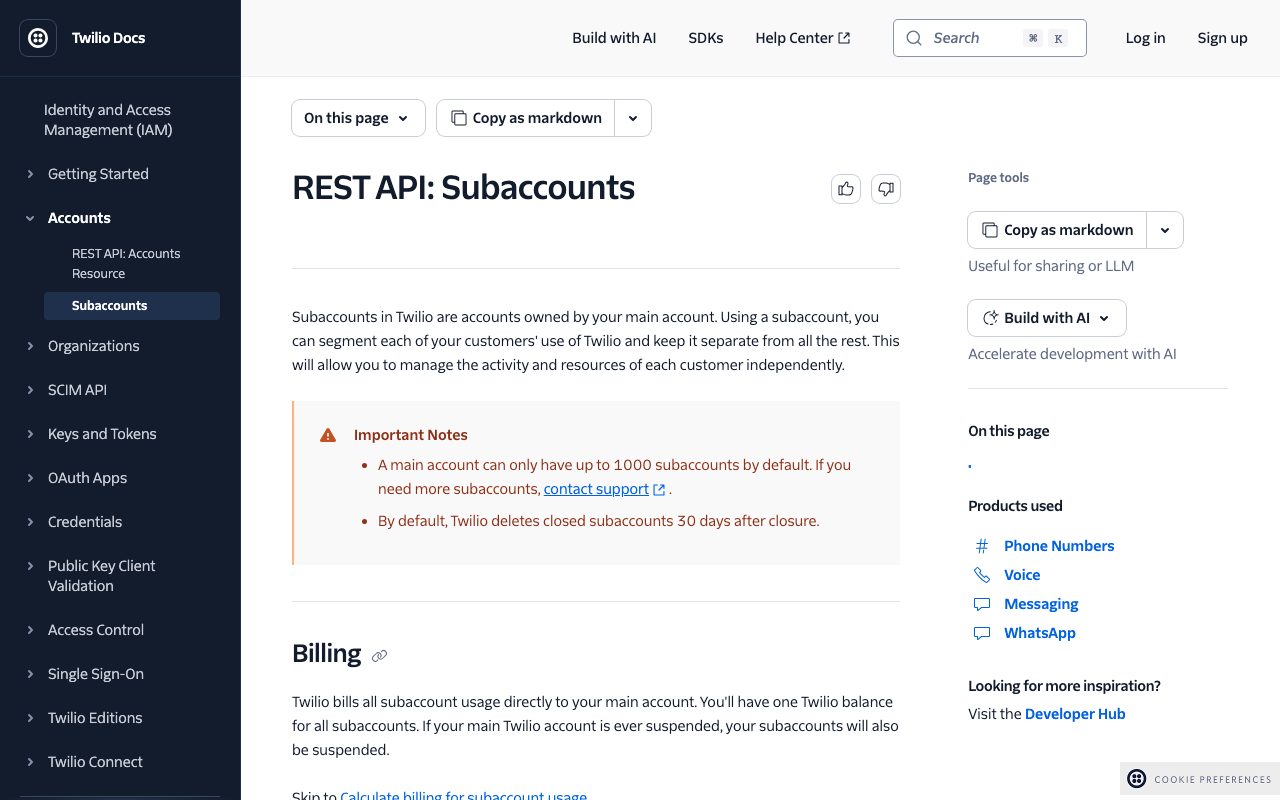
Twilio bills all subaccount usage to the main account. Screenshot of twilio.com, taken on 7 October 2026.
That design has three consequences for a reseller:
- You are the billing system. Twilio does not invoice your customers, hold a balance for each of them or apply your markup.
- You can suspend or close a customer by API. Closing a subaccount releases all of its numbers, according to the same subaccounts page.
- Moving a number between accounts is not free of side effects. Twilio says toll-free verifications, A2P registrations and Trust Hub enrolments "will need to be resubmitted and reconfigured" (Twilio subaccounts docs).
Twilio's strength is that this path is well documented. Its ISV guide lays out which account layouts work with US messaging registration and calls the one where "you use subaccounts and they are mapped to individual customers", together with Messaging Services, "the preferred architecture" (Twilio ISV onboarding guide).
How each alternative separates and bills customers
Every vendor here offers a per-customer container, but only Telnyx and Vonage document a customer-level balance. The table shows what each vendor's own pages say. Prices are US list prices for one local 10-digit number, before carrier surcharges and volume discounts, as displayed on 7 October 2026.
| Vendor | Per-customer structure | Who is billed | Access | US local number per month |
|---|---|---|---|---|
| Twilio | Subaccounts, 1,000 by default (docs) | Main account, one balance | Self-service | $1.15 (pricing) |
| Telnyx | Managed accounts, 1,000 by default (support article) | Your choice: rollup to the manager account, or separate billing per managed account | Starter plan or above; not on pay-as-you-go | $1.00 (pricing) |
| Plivo | Subaccounts with their own Auth ID and token (docs) | Main account balance | Self-service | $0.50 (pricing) |
| Sinch | Subprojects, one per customer (docs) | Parent project only | "Selected customers only", through an account manager | $1.00, plus $1.00 setup (pricing) |
| Vonage | Subaccounts (docs) | Shared with the primary account by default, or the subaccount's own balance | Restricted; partners get access automatically | Not found on a primary page |
| Bandwidth | Sub-accounts (sites) containing locations (docs) | Not stated on the page opened | Not stated | Not found on a primary page |
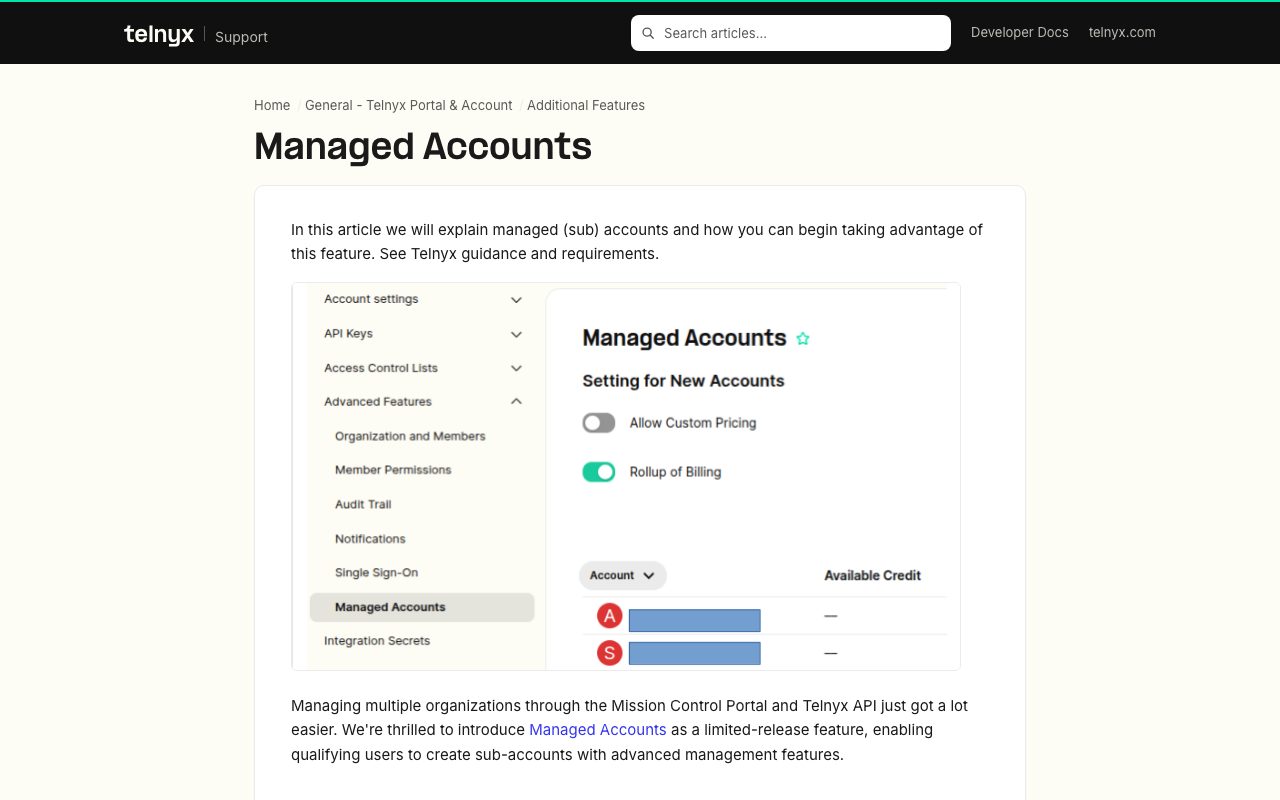
Telnyx calls its sub-accounts managed accounts. Screenshot of support.telnyx.com, taken on 7 October 2026.
A few details matter more than the table can show.
Telnyx has the most flexible billing of the group. With rollup billing, spend from a managed account is recorded against the manager account; with separate billing, each managed account keeps its own balance, payment methods and invoices (Telnyx managed accounts). The catch is the entry price: the feature requires a commitment plan, starting with Starter at a $1,000 per month minimum or Growth at $2,000, and is not available on pay-as-you-go accounts, according to the same article.
Plivo is the simplest to start with. Subaccounts are self-service, each one can see only its own resources, and Plivo says you can "track usage per subaccount via API for client invoicing". When you delete a subaccount, its numbers move to the main account unless you ask for a cascade delete (Plivo subaccounts docs).
Sinch describes subprojects as built for "scenarios where you act as a reseller", with usage measured per customer, but the subproject API is "available to selected customers only" (Sinch subprojects overview). It suits a reseller who already has a Sinch account manager.
Vonage is the only vendor whose page, among those opened here, describes moving money between you and a customer account. A subaccount shares the primary balance by default; setting it to use its own balance is irreversible, and you can then transfer balance or credit in either direction (Vonage subaccounts overview). The API has restricted availability: Vonage says to contact an account manager, and that partners get access automatically.
Bandwidth documents a hierarchy of account, sub-account and location, and recommends at least a production and a development sub-account. The page describes organising numbers, not billing customers, and warns against exceeding 250 locations (Bandwidth account structure). Its pricing page returned an error when opened on 7 October 2026, as did the Vonage SMS pricing page, so no price is quoted for either.
What white-labelling means with these vendors
White-labelling at a carrier API means your customers see only what you build, because the vendor's console is yours, not theirs. None of the subaccount pages above describes a branded portal that you can hand to a customer. You put your own interface, invoices and support in front of the API.
Telnyx's partner page mentions "white-label capabilities" for agencies and "white-label tools" for distributors, and "competitive commissions" for channel partners, but publishes no rates or entry requirements (Telnyx partners). For a wider view of what the term covers, see what a white-label reseller platform is.
How much margin room there is
No vendor we checked publishes a reseller discount or wholesale price list, so your margin is your retail price minus list price and your own costs. Volume is the main lever. Telnyx lists number tiers that step down from $1.00 to $0.79, $0.50, $0.39 and finally $0.25 per month at 5,000 or more numbers (Telnyx numbers pricing). Twilio and Plivo mention volume or committed-use discounts without printing the tiers (Twilio pricing, Plivo pricing).
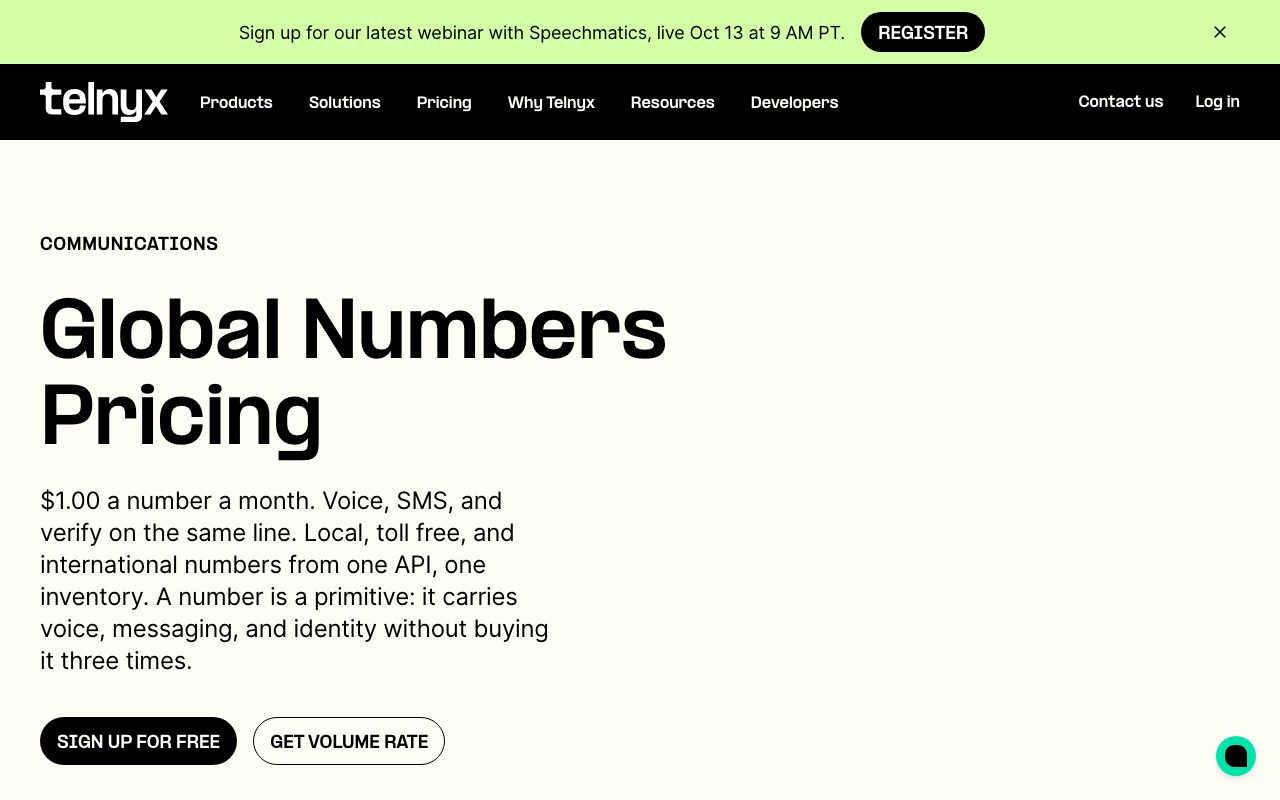
Telnyx advertises numbers from $1.00 a month. Screenshot of telnyx.com, taken on 7 October 2026.
Here is the list-price cost of a small book of business: 100 customers with one US local number each, receiving 100 SMS a month per number, so 10,000 inbound messages in total. Carrier surcharges are excluded.
| Vendor | Number rental | Inbound SMS rate | Inbound SMS cost | Monthly total |
|---|---|---|---|---|
| Twilio | $115.00 | $0.0083 per segment (pricing) | $83.00 | $198.00 |
| Sinch | $100.00 | $0.0078 (pricing) | $78.00 | $178.00, plus $100 one-off setup |
| Telnyx | $100.00 | $0.004 per message part (pricing) | $40.00 | $140.00 |
| Plivo | $50.00 | $0.0077 (pricing) | $77.00 | $127.00 |
The totals are our arithmetic on the linked list prices, as displayed on 7 October 2026. Two things change the picture. First, the Telnyx figure assumes plain pay-as-you-go; if you want managed accounts, the $1,000 monthly plan minimum is far above $140 of usage at this size (Telnyx managed accounts). Second, the spread between cheapest and dearest is $71 a month across 100 customers, under a dollar per customer. At this size the choice of vendor moves cost by less than a dollar per customer, so the billing and compliance work described below is the larger variable.
Who carries the compliance responsibilities
You do: the vendor's contract is with you, and you answer for your customers. Twilio's Acceptable Use Policy, last updated 12 May 2025, says the "Customer is responsible for its End Users' compliance with this AUP" (Twilio AUP).
For US messaging the duty is specific. Twilio states that "anyone sending SMS/MMS messages over a 10DLC number from an application to the US must register for A2P 10DLC" (Twilio A2P 10DLC docs), and its ISV guide makes you responsible for gathering each customer's business details and registering them under that customer's name, not yours (Twilio ISV onboarding guide). Telnyx's checklist for ISVs and resellers goes further: register a separate brand per customer, verify that the customer's business is legitimate, monitor message content, make STOP and HELP work, and keep opt-in records for at least four years (Telnyx ISV and reseller onboarding).
That work has a price per customer. Telnyx lists a $4.50 brand registration, $15 per campaign review, and a monthly campaign fee from $1.50 (low-volume mixed) to $10 (most standard use cases), in a table dated 22 July 2025 (Telnyx 10DLC fees). The same page lists T-Mobile non-compliance fines that are passed through, including $10,000 for a text-enablement violation. In the 100-customer example, a $1.50 campaign for each customer adds $150 a month, which is more than the Plivo number rental. Twilio's ISV guide says each brand carries its own registration fee but does not print the amounts, so no Twilio figure is quoted.
All of these rules are written around sending. Whether a number that only receives SMS needs registration was not found on a primary page, so ask the vendor before you assume either way. The inbound side is covered in phone number APIs for receiving SMS.
When a reseller platform with a prepaid wallet is simpler
A reseller platform is simpler when you sell one narrow thing and do not want to write the money-handling code around a carrier API. On the vendors above, the parts you build yourself are a balance for each customer, a rule for what happens when an order half-fails, renewals, and a fallback when a provider has no stock. A platform that sits between you and the carriers does those once. The mechanics are explained in prepaid wallet billing for resellers.
ResellerHQ, which publishes this blog, is one such platform, and its scope is much narrower than any vendor in this article. Per its own documentation:
- Numbers are rentals that receive SMS, for fixed periods from 12 hours to 365 days. The docs describe no voice, no outbound SMS and no porting (numbers guide).
- The wallet is prepaid in US dollars. An order reserves its total, charges only for numbers that are delivered, and returns the rest; a failed order costs nothing (wallet guide).
- An order is tried with the cheapest upstream provider first and falls through to the next, and the price shown does not change with the provider.
- The API has customer records, and an order can carry a customer id so you can track who has what. Charging those customers is still your job.
The limits are real. ResellerHQ is in early access, and live numbers are open only on accounts with a carrier enabled and depend on an upstream provider. There is no published price list; prices appear in the dashboard and from the offers endpoint once you have an account. Live wallet top-ups are by invoice, as card payments are not connected. It has no customer stories or benchmarks to show. Its other two product lines, domains and mailbox licences, run in the sandbox only for now. You can test the full number flow with test funds in the sandbox.
How to choose
Pick by what your customers need and how much billing you want to own:
- Voice, two-way messaging, porting, and you will build billing yourself: Twilio for the documented ISV path, or Plivo for the lowest listed US number rental and self-service subaccounts.
- Customers who should pay the carrier directly or hold their own balance: Telnyx managed accounts with separate billing, if the plan minimum fits, or Vonage subaccounts if you can get access.
- An existing enterprise relationship: Sinch subprojects or Bandwidth sub-accounts, both arranged with the vendor.
- Receive-only numbers sold under your brand, with no wish to build wallet logic: a reseller platform, accepting the narrower feature set.
Whichever you choose, write down the per-customer compliance cost before you set a retail price, because it does not appear on any number pricing page.
Questions
- Yes. Twilio subaccounts exist to segment each customer's usage, with a default limit of 1,000 subaccounts, and Twilio bills all subaccount usage to your main account. You invoice your customers yourself, and you are responsible for their compliance with Twilio's Acceptable Use Policy.
- On list prices displayed on 7 October 2026, Plivo is lowest at $0.50 per month for a US long code, against $1.00 at Telnyx and Sinch and $1.15 at Twilio. Telnyx lists volume tiers that fall to $0.25 per number per month at 5,000 or more numbers.
- Telnyx managed accounts can be billed separately, each with its own balance and payment method, and Vonage subaccounts can be given their own balance instead of sharing the primary account's. Twilio, Plivo and Sinch document a single parent balance or billing link.
- If your customers send application-to-person SMS to US numbers over 10-digit long codes, yes. Twilio and Telnyx both require an ISV or reseller to register a brand and campaign for each customer. Whether numbers used only to receive SMS need registration was not found on a primary page.
- No vendor we checked publishes reseller margins or a wholesale price list. Your margin is whatever you charge above list price, less per-customer compliance fees, payment costs and support.
- When you sell a narrow product, such as numbers that receive SMS, and do not want to build balance tracking, refunds for failed orders, renewals and provider failover yourself. It is not simpler if you need voice, outbound messaging or number porting, which the carrier APIs provide.
Sources
- Twilio: Subaccounts API documentation twilio.com
- Twilio: SMS pricing in the United States twilio.com
- Twilio: A2P 10DLC documentation twilio.com
- Twilio: A2P 10DLC onboarding guide for ISVs twilio.com
- Twilio: Acceptable Use Policy twilio.com
- Telnyx: Managed accounts support article support.telnyx.com
- Telnyx: Numbers pricing telnyx.com
- Telnyx: Messaging pricing telnyx.com
- Telnyx: ISV and reseller 10DLC onboarding developers.telnyx.com
- Telnyx: 10DLC fees and charges support.telnyx.com
- Telnyx: Partner programme telnyx.com
- Plivo: Subaccounts concepts documentation plivo.com
- Plivo: SMS pricing in the United States plivo.com
- Sinch: Subprojects overview developers.sinch.com
- Sinch: SMS pricing sinch.com
- Vonage: Subaccounts API overview developer.vonage.com
- Bandwidth: Account structure documentation dev.bandwidth.com